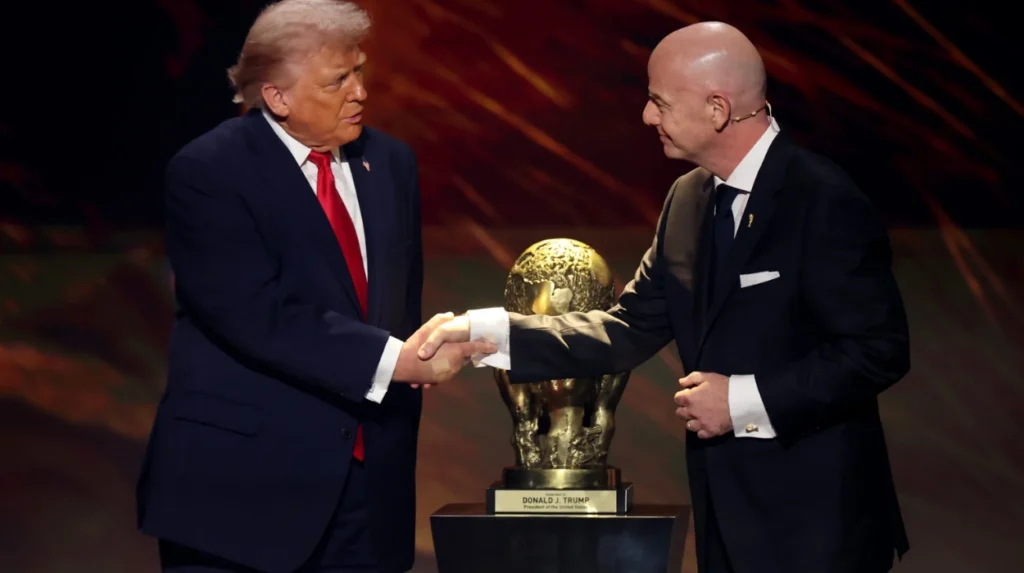
Members of the European Parliament have asked FIFA to investigate Gianni Infantino over the FIFA Peace Prize awarded to Donald Trump, turning what might once have been dismissed as an awkward public-relations moment into a serious governance dispute. The request is not just about the optics of the award; it reflects concern that FIFA’s president may have overstepped the organization’s ethical and political boundaries by creating and presenting a prize with obvious geopolitical implications.
At the heart of the lawmakers’ concern is whether FIFA remained true to its own rules on neutrality and accountability. When an institution that governs the world’s most popular sport is seen to be making symbolic gestures toward a serving political leader, critics argue that the issue becomes one of institutional independence rather than mere ceremony.
FIFA’s Political Neutrality Under Scrutiny
FIFA’s statutes and ethics rules place political neutrality at the center of the organization’s identity, because football’s governing body has long argued that it should not be used as a platform for partisan or state political messaging. That principle matters not only in formal disputes over protests or national-team conduct, but also in the symbolism of awards, public appearances, and relationships with political figures.
The Peace Prize controversy puts that neutrality claim under pressure because it raises a simple but difficult question: can FIFA credibly present itself as politically neutral if its president creates or endorses an award for a sitting political leader? Even if the intention was diplomatic or reconciliatory, the act itself risks being interpreted as an institutional endorsement rather than a neutral recognition.
The Governance Questions Behind the Peace Prize
The strongest criticism of the FIFA Peace Prize is not simply that it was awarded to Donald Trump, but that the decision-making process surrounding it appears unclear. Governance concerns arise when a major symbolic action seems to have been shaped by a very small circle, without visible consultation, published criteria, or a transparent explanation of how the award was conceived.
That lack of clarity matters because FIFA has spent years trying to rebuild trust after scandals that damaged its credibility. If the process behind a new prize is opaque, critics will naturally ask whether it reflects proper institutional oversight or the judgment of a powerful individual acting with too much freedom.
How Gianni Infantino’s Leadership Faces Fresh Criticism
Gianni Infantino has long been criticized by observers who say FIFA’s governance has become more centralized under his leadership. Supporters argue that strong leadership is useful in a global organization that must coordinate with governments, sponsors, confederations, and tournament hosts. Critics respond that centralization can weaken internal checks, especially when major decisions are closely associated with the president’s personal diplomacy.
This latest controversy fits that pattern because it suggests that a highly visible political gesture may have emerged from executive discretion rather than collective institutional process. In that sense, the debate is not only about one prize or one moment, but about whether FIFA’s governance model has become too dependent on the preferences and instincts of its president.
Can Sport and Global Politics Remain Separate?
In practice, football and politics are never fully separate. FIFA regularly works with governments on World Cup planning, security, infrastructure, visas, and diplomatic coordination, and those relationships are unavoidable for an organization that stages global events. Supporters of Infantino argue that engaging political leaders is a necessary part of the job, not evidence of wrongdoing.
Still, there is a difference between necessary engagement and symbolic recognition. Awarding a FIFA Peace Prize to a serving political leader blurs that distinction and creates the impression that FIFA is moving from cooperation into political validation. That is exactly why the controversy has triggered concern among ethics observers and lawmakers.
Transparency Concerns Inside FIFA’s Decision-Making
Transparency is central to this story because the legitimacy of sporting institutions depends not only on what they do, but on how openly and fairly they do it. If the Peace Prize was created quickly, without public criteria or clear institutional review, the result is a governance problem even before any ethics judgment is made.
This is where FIFA’s own credibility is tested. A governing body that wants to be seen as modern and accountable cannot rely on vague explanations when it makes a politically sensitive decision. The more opaque the process appears, the more the controversy resembles a question of institutional control rather than ceremonial discretion.
What This Controversy Means for FIFA’s Credibility
The wider damage from this episode may fall on FIFA itself rather than on any one individual. FIFA’s post-reform identity depends on the idea that the organization has become more transparent, more ethical, and more resistant to the kind of personalization that once made it a target of global criticism. A controversy like this reopens doubts about whether those reforms have changed the culture as much as they changed the structure.
That is why the European Parliament’s intervention matters beyond the immediate dispute. It signals that FIFA is still being watched closely by outside institutions that measure the organization not only by its commercial success, but by its ability to uphold basic standards of football governance.
The Bigger Debate Over FIFA’s Future Governance
The deeper issue is whether sporting bodies should involve themselves in recognizing geopolitical or peace-related achievements at all. Some argue that global sport has a responsibility to encourage dialogue and can sometimes play a constructive symbolic role in international relations. Others believe that once organizations like FIFA begin honoring political figures, they move into territory that risks undermining their neutrality and confusing their mandate.
This controversy also recalls earlier episodes in which football institutions were criticized for their closeness to political power, whether through World Cup diplomacy, host-country relationships, or high-profile symbolic acts that looked like soft endorsement. The pattern is familiar: when the governing body of football becomes too comfortable in the language of statecraft, questions about independence inevitably follow.
In that sense, the FIFA controversy over the Donald Trump Peace Prize is about more than a single award or a single president. It is a test of whether FIFA can still persuade the public that its ethical rules mean something, its decision-making is accountable, and its role in global football remains separate from political theater.