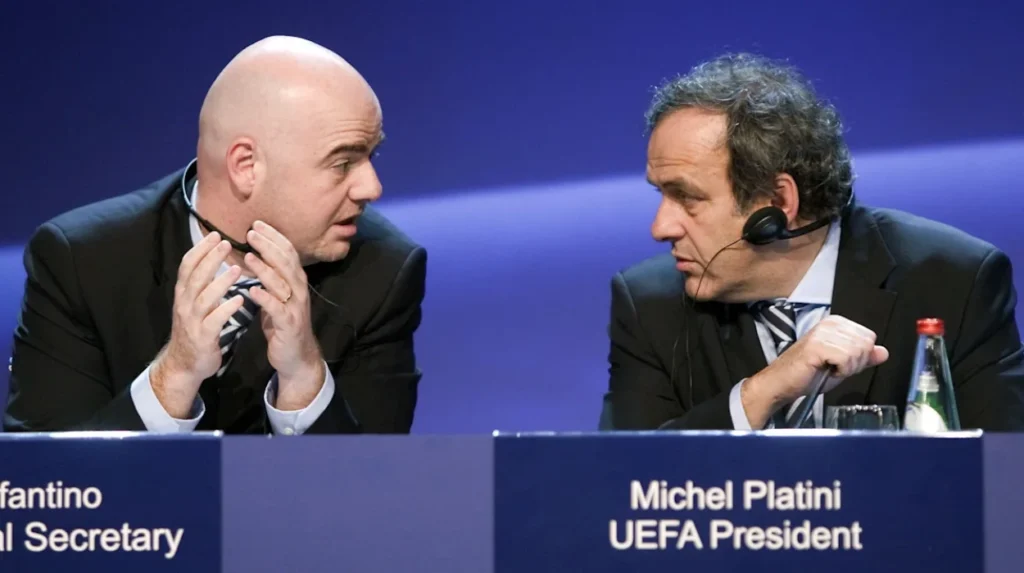
Michel Platini has launched a fresh legal assault on FIFA and its president, Gianni Infantino, reviving one of the most consequential governance disputes in modern football. The move follows Platini’s acquittal in the long-running Swiss case tied to the 2 million Swiss francs payment from Sepp Blatter, and it reopens unresolved questions about FIFA governance, football politics, due process, and the integrity of football administration.
The latest Michel Platini lawsuit is more than a personal grievance. It is a direct challenge to the institutional memory of FIFA corruption allegations, the conduct of its ethics machinery, and the political events that reshaped the FIFA leadership race in 2015 and 2016.
How the FIFA Controversy Began
The roots of the FIFA controversy lie in the payment made by Sepp Blatter to Michel Platini for work carried out years earlier. The arrangement became the focus of Swiss prosecutors in 2015, and the fallout quickly spread into FIFA’s internal disciplinary system, where Platini faced ethics sanctions that suspended him from football at the very moment he was expected to succeed Blatter.
That sequence changed the course of world football. Platini’s suspension effectively removed him from the FIFA presidential election, allowing the leadership contest to reset under crisis conditions and clearing the path for Gianni Infantino, then a senior UEFA official, to emerge as the eventual winner. The case therefore became not only a legal dispute but a defining event in football politics and FIFA’s post-scandal transition.
Why Platini’s Fresh Lawsuit Matters
Platini’s fresh legal action matters because it attempts to do more than revisit the original payment dispute. Reports indicate that he is alleging a wider effort to damage his reputation and block his ascent to the FIFA presidency, while also seeking compensation through civil proceedings. Those are allegations, not findings, and they remain subject to judicial determination.
The significance of the case goes beyond Platini himself because it tests whether a senior figure can be removed from the top of international football through a combination of criminal scrutiny, internal ethics action, and delayed judicial resolution. If the legal challenge gains traction, it could deepen scrutiny of whether FIFA’s disciplinary ecosystem has been used in ways that produced institutional winners and losers long before a court could make a final ruling.
FIFA Governance Under Pressure
This dispute has returned FIFA governance to the centre of debate because it exposes the gap between formal reform and public trust. FIFA has spent years arguing that it strengthened its ethics committee, compliance systems, and disciplinary architecture after the scandals of the Blatter era, yet the persistence of this case suggests that many observers still question whether those reforms fully solved the problems of independence and accountability.
A core issue is whether FIFA’s internal structures can be seen as genuinely separate from leadership politics. Even when committees act within their formal authority, their decisions can have enormous political consequences, especially when they involve a presidential contender. That is why the renewed legal battle is being read not merely as a legal dispute but as a test of the credibility of sports governance itself.
The Rise of Gianni Infantino
Gianni Infantino’s rise to FIFA leadership cannot be separated from the removal of Platini from the contest. The political context matters because Platini had been widely viewed as a leading figure in the succession race until the ethics proceedings and suspension changed the balance of power.
Critics have long argued that the timing of the crisis allowed one leadership pathway to collapse while another advanced. Infantino has denied wrongdoing and has previously been cleared in separate ethics proceedings, but the new allegations have revived discussion about how much executive authority FIFA places in the hands of its president and whether the organization’s political culture encourages concentration of power. Platini’s claims remain allegations unless proven in court, yet they have already reopened debate over FIFA leadership and decision-making.
Did FIFA Fail Due Process?
The Platini affair raises a difficult question: can due process in sports ever be truly fair if sanctions are imposed before court proceedings are complete? In high-profile cases, internal disciplinary action can move quickly, while criminal and civil litigation can drag on for years. By the time a defendant is acquitted, the professional damage may already be permanent.
That problem is particularly acute in football administration, where reputational judgments often arrive before legal certainty. If a governing body acts decisively on incomplete or contested facts, it may believe it is protecting the sport, but it may also be inflicting irreversible harm on individuals who are later cleared. The Platini case suggests that international federations may need to rethink how and when they impose disciplinary measures in politically sensitive investigations.
Ethics, Politics and Power in Football
Elite football has never been free from power struggles, coalition-building, and electioneering. The Platini-Infantino saga reflects a broader reality of football politics: governance disputes are rarely just about rules, and they are often also about alliances, timing, and institutional leverage.
That is why controversies involving FIFA ethics committee proceedings can have consequences far beyond the individuals named in them. When governance systems are strong, they can resist political pressure; when they are weak, they risk becoming tools in broader struggles for control. This case is a reminder that the legitimacy of major football institutions depends not only on written statutes but on whether stakeholders believe those statutes are applied without fear or favour.
The Cost of Reputation in Sport
Even a legal victory may not fully restore what was lost. Platini’s acquittal did not erase the years of exclusion, the collapse of his presidential ambitions, or the long-term reputational damage associated with being linked to FIFA corruption allegations. That is why his new claim also speaks to a wider issue in sports governance: whether law can ever fully compensate for lost status, lost opportunity, and public humiliation.
Sporting bodies often defend their decisions by pointing to internal rules and urgent institutional needs, but they rarely confront the full human cost of those decisions once a case is resolved in court. If disciplinary actions later appear questionable, institutions have a responsibility to assess whether their processes were proportionate, transparent, and respectful of fairness from the outset. The Platini case forces that conversation back into view.
What This Means for FIFA’s Future
The new case could affect FIFA’s credibility even if it does not result in immediate legal liability. Once again, the organization finds itself defending its past, its leadership culture, and the procedures that were meant to rebuild trust after the crisis years. For FIFA, the challenge is not simply to win a legal argument but to demonstrate that its reforms have created real institutional accountability.
More broadly, the case may influence how other international sports bodies handle ethics investigations, executive disputes, and disciplinary action during active legal proceedings. If the courts eventually examine the claims in depth, the outcome could shape future thinking on transparency, governance reform, and procedural fairness across world sport. What remains clear now is that the Michel Platini lawsuit has reopened a debate FIFA would have preferred to leave in the past.
Platini’s new action will be judged by the courts, but the wider lesson is already visible. The case has revived critical questions about FIFA governance, accountability, transparency, due process, and the political power structures that continue to shape football administration at the highest level.