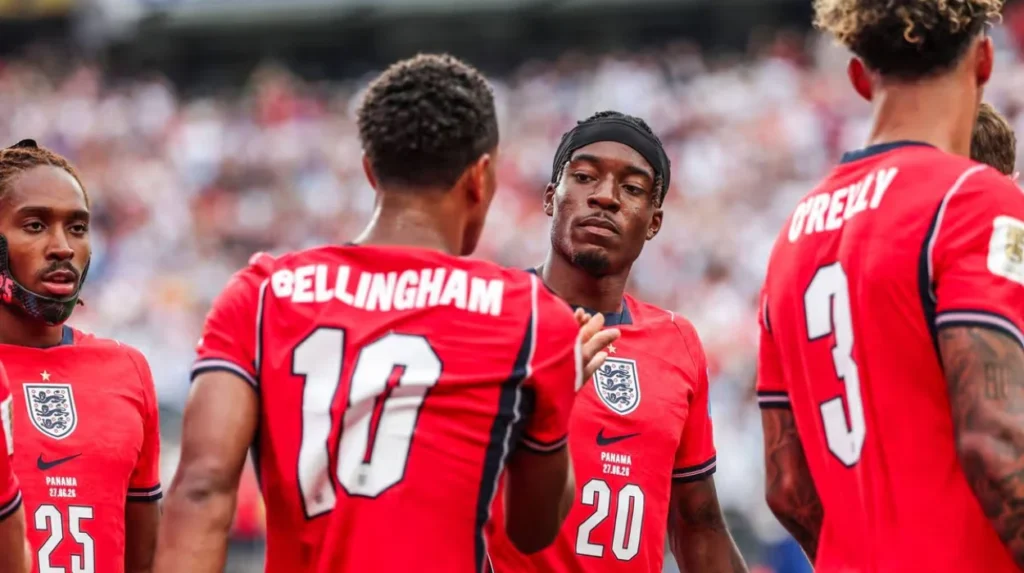
England’s path at the FIFA World Cup 2026 now includes another knockout fixture, a small scheduling detail that says a great deal about how the tournament has changed. What was once a straightforward route from group stage to the last 16 has become a more crowded, commercially larger, and physically more demanding competition, with the new Round of 32 reshaping the World Cup format from the first knockout step onward.
Why England Must Play an Extra World Cup Match
The expanded FIFA World Cup has changed the tournament’s basic structure, and England now find themselves with one additional knockout hurdle before reaching the traditional latter stages. Under the old 32-team format, the knockout phase began with the last 16, but the 48-team World Cup introduces a Round of 32, adding an extra elimination round for teams that advance from the groups.
That matters because the change is not limited to England or any one federation. It is part of the wider FIFA expansion, and it affects the logic of the entire competition. For a country like England, whose World Cup campaigns are often judged by results rather than style, the difference is significant: one more game, one more chance for variance, and one more layer of pressure before the tournament truly enters its decisive phase.
How the 48-Team World Cup Changes Football
The 48-team World Cup alters more than the number of participants. It changes the competitive rhythm of international football by extending the knockout path and increasing the total number of matches needed to lift the trophy. In practical terms, that means the tournament now rewards depth, adaptability, and squad management even more heavily than before.
Supporters of expansion argue that this is a fairer, more global World Cup format. More nations qualify, more regions are represented, and more players experience the game’s biggest stage. But the sporting downside is obvious: the larger the tournament becomes, the harder it is to maintain the same intensity, equality, and clarity of competition that defined the 32-team version.
The Hidden Cost of an Expanded Tournament
Every extra match in elite football carries a cost, and the new Round of 32 adds another physical and mental test to an already compressed World Cup schedule. Players arrive at the tournament after long club seasons, often having already dealt with domestic leagues, European competitions, and international windows. The result is a clear case of fixture congestion, where the calendar gives elite players very little opportunity to recover properly.
That issue is especially serious for footballers from Europe’s major leagues, where the demands are already relentless. A World Cup expansion that increases the number of matches may improve the tournament’s reach, but it also increases the strain on players who are expected to peak repeatedly across an exhausting football calendar. In that sense, the extra knockout round is not a neutral administrative change; it is a direct addition to workload at the most physically demanding level of the sport.
Player Welfare vs FIFA’s Ambitions
Player welfare has become one of the defining arguments against the modern expansion of international football. The concern is simple: if FIFA keeps adding matches without reducing pressure elsewhere in the calendar, then recovery time shrinks and injury risk rises. That concern is not based on emotion. It follows basic sports science, where fatigue is closely linked to reduced performance, slower reaction time, and higher injury susceptibility.
FIFA says the expanded tournament improves access and inclusivity, giving more countries a place at the World Cup and strengthening global football development. That argument cannot be dismissed. The World Cup is meant to be a global event, not an exclusive club. Still, critics say the timing and scale of expansion suggest that the organization is also protecting and enlarging its own commercial model, even when player workload is already at a critical level.
Is FIFA Prioritizing Revenue Over Competition?
The commercial logic behind expansion is hard to ignore. More teams mean more matches, and more matches mean more broadcasting rights, sponsorship opportunities, ticket sales, and advertising inventory. For FIFA, that creates a stronger business model around the FIFA World Cup 2026, especially at a time when global media value in elite sport remains enormous.
That is why many observers view FIFA commercial strategy and sporting reform as increasingly intertwined. The organization can credibly argue that more nations should be included, but the financial benefits of a larger tournament are also obvious. The criticism is not that FIFA earns money; it is that football governance often appears to move in the same direction as revenue growth, even when the sporting cost is clear.
Bigger Tournament, Bigger Governance Questions
FIFA governance has long been scrutinized because its major reforms tend to expand football’s scale while raising concerns about accountability and sporting balance. The move to a 48-team World Cup illustrates that tension. On one side is the promise of broader participation and development across international football. On the other is the feeling that structural decisions are increasingly shaped by the organization’s need to grow its global footprint and revenue base.
That does not mean expansion is automatically wrong. A wider World Cup can help emerging football nations gain experience and visibility, which can matter over the long term. But governance criticism remains valid because major reforms should be judged not only by how much money they generate or how many countries they include, but by whether they protect competitive integrity and respect player welfare.
Does World Cup Expansion Improve Football?
The honest answer is that it does both, depending on what standard is used. From a development perspective, a larger tournament can help broaden the game’s reach and create new football audiences. For nations that have struggled to qualify under the old system, the World Cup expansion is meaningful because it opens a door that was previously narrow or closed.
From a competitive perspective, however, there is a risk that the quality of matches becomes more uneven. The new format may produce more one-sided group-stage games, more tactical caution in certain fixtures, and a stronger dependence on squad depth. Nations with deep benches are likely to benefit, while smaller countries may find the jump in demands much harder to absorb. That is not a flaw in the abstract, but it is a real sporting consequence of expansion.
What FIFA’s New Format Means for the Future
The new World Cup format signals where international football may be heading: more matches, larger tournaments, and stronger commercial returns. The question is whether that future improves the sport or simply increases its scale. A Round of 32 creates more knockout drama, but it also adds another layer of unpredictability, where injuries, suspensions, officiating decisions, and scheduling pressure can weigh even more heavily on outcomes.
That unpredictability can make the tournament more dramatic, but it can also make it less pure. Success may depend less on sustained excellence across a concentrated field and more on survival through a longer, more physically taxing route. For coaches, this means deeper planning. For players, it means less margin for error. For governing bodies, it means the need to explain why the sport’s most prestigious event is being stretched so far.
England’s extra World Cup game is a practical result of FIFA’s expanded tournament, but it also reflects a wider shift in international football toward bigger competitions, greater commercial value, and heavier demands on players. The 48-team World Cup may broaden access and increase global participation, yet it also raises serious questions about player welfare, fixture congestion, and whether FIFA’s reforms are moving football forward competitively or mainly expanding the business of the game.