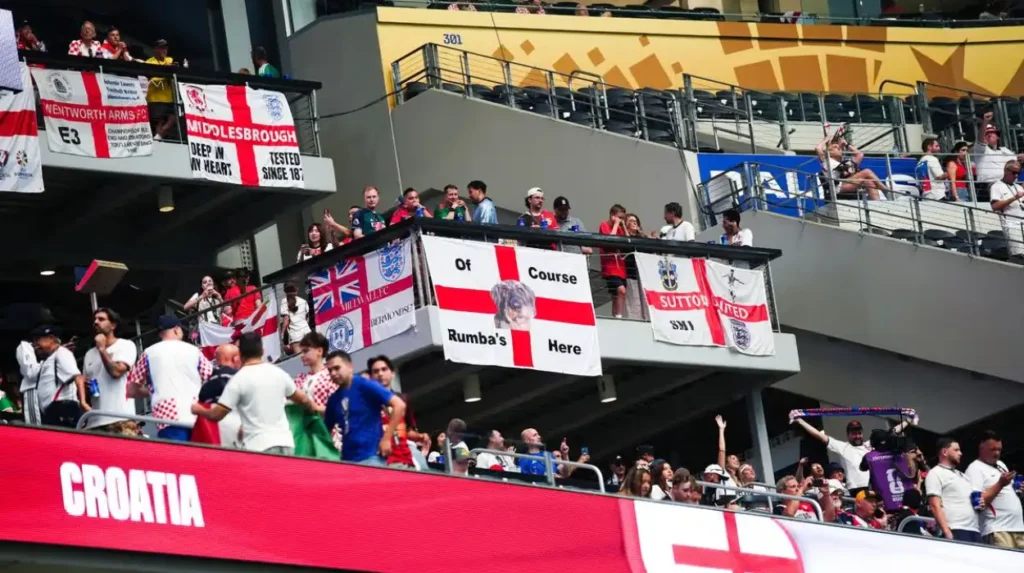
FIFA’s rejection of a Barrow AFC-inspired England fan flag, because it included the club’s submarine badge, is a minor incident only in appearance. In reality, it reveals something larger about how the global game is being governed: increasingly by rigid compliance rules, increasingly by narrow interpretation, and increasingly by an institution that seems more comfortable with control than context.
The immediate issue is straightforward. A flag created by England supporters was refused entry because FIFA regarded the submarine in the Barrow badge as military imagery. What makes the decision controversial is not simply that a rule was applied, but that a symbol with clear local and historical meaning was treated as if it were an unambiguous sign of militarism.
Why a Submarine Symbol Was Rejected
A submarine is the kind of image that can be read in more than one way, and that is precisely why this case has drawn attention. In Barrow’s case, the symbol is tied to the town’s shipbuilding identity and the club’s badge, rather than any attempt to promote warfare or aggression. To many supporters, that distinction should have been obvious.
FIFA’s treatment of the flag suggests a rulebook that is better at identifying objects than understanding intent. Once a symbol is placed inside the category of “military imagery,” the process appears to stop there. That kind of literalism may simplify enforcement, but it also strips away the contextual judgment that a serious governing body ought to apply.
The Growing Control Over Fan Expression
This controversy also speaks to a broader shift in modern tournament football. Fan expression, once central to the culture of the stands, is now increasingly filtered through approval systems, size limits, content checks, and security reviews. The stadium is still full of colour, but much of that colour is now pre-approved.
That may be understandable to a point. Major FIFA events involve complex logistics and legitimate safety concerns. Yet the effect is to turn supporter identity into something managed rather than organic, where the most meaningful gestures are the ones least likely to be challenged by compliance staff. The game loses some of its spontaneity when every banner must first satisfy an administrative test.
How FIFA Interprets “Military Imagery”
The phrase “military imagery” sounds clear enough until it is tested against real-world symbols. A submarine is, technically, a military vessel in some contexts. But that does not mean every submarine image carries a military message, especially when it appears in a club badge or local emblem. In football, symbols are often historical, industrial, nautical, civic, or cultural long before they are political.
That is the central flaw in this decision. FIFA seems to have applied a category without enough sensitivity to meaning. The result is a rule enforcement system that may be internally consistent but externally absurd. In governance terms, that is a serious weakness, because it encourages the public to see policy as detached from common sense.
Gianni Infantino and FIFA’s Image Management Strategy
This incident also sits uneasily within the leadership style associated with Gianni Infantino. FIFA under his presidency has often projected an intense interest in image control, messaging discipline, and the presentation of a tightly managed global product. That approach may create order, but it also creates a governing culture in which nuance can be sacrificed for neatness.
The problem is not that Infantino personally oversees every fan flag decision. It is that the institution he leads increasingly behaves like an organization worried about appearances first and atmosphere second. When a club badge is treated like a threat, the public is left with the impression of a bureaucracy more concerned with risk management than with football’s social texture. That perception is damaging, even if the officials involved believed they were simply following procedure.
Inconsistencies in FIFA’s Stadium Approval System
One of the most frustrating aspects of incidents like this is how uneven they make FIFA’s approval process appear. The regulations around flags and banners are strict enough to allow the governing body wide discretion, but not always transparent enough to reassure supporters that the discretion is being used intelligently. That creates uncertainty at the point where fans most need clarity.
The result is a system that can feel arbitrary. One symbol passes, another is rejected, and the difference is not always explained in a way that makes sense to ordinary supporters. In a high-profile international tournament, that kind of inconsistency damages trust. It suggests that FIFA’s enforcement culture is built more around caution than coherence, and more around blocking potential problems than distinguishing between genuine risks and harmless expression.
Cultural Identity vs Global Tournament Regulations
The deeper conflict here is between local identity and global regulation. Football clubs carry civic memory, industrial heritage, regional pride, and historical symbolism in ways that are often inseparable from their badges and flags. When those symbols are transported into a World Cup setting, they do not cease to be meaningful simply because they enter a controlled environment.
That is why the Barrow flag case matters beyond the club itself. It reflects a broader tension at the heart of FIFA tournaments: the organization wants a global stage, but it often struggles to accommodate the local meanings that make football worth staging in the first place. The more aggressively it standardizes supporter expression, the more it risks flattening the very diversity that gives international football its appeal.
What This Means for Future World Cup Fan Culture
If FIFA continues down this path, the long-term consequence may be a narrower and more cautious fan culture at future World Cups. Supporters will still attend, sing, and display colour, but they may do so within a tighter visual perimeter shaped by pre-approval and risk aversion. That is not just a logistical matter; it is a cultural one.
Football’s most memorable tournaments have always had a strong relationship with supporter creativity. Flags, banners, and improvised symbols are part of how fans make the occasion their own. If governing bodies increasingly regulate that expression with blanket restrictions and limited contextual judgment, the stadium may remain full but feel less alive. FIFA may call that professionalism; many supporters will see it as over-control.
The Barrow submarine flag controversy is not a world-changing scandal, but it is revealing. It shows how easily FIFA’s regulatory instincts can become overly literal, how little room there sometimes is for cultural interpretation, and how quickly a governing body can appear detached from the realities of football support.
For Gianni Infantino’s FIFA, the problem is not only the rule itself. It is the impression that the institution is building a global tournament model in which symbolism is managed too tightly, fan expression is monitored too aggressively, and common sense is too often the first casualty of process. That is a governance issue, and one FIFA would be wise to confront before similar episodes become routine.