
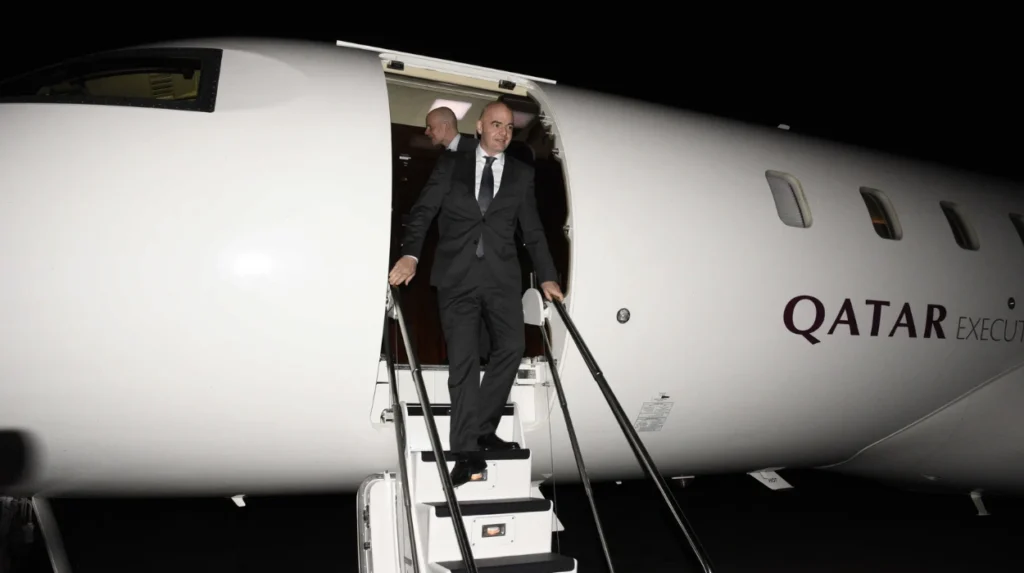
The controversy surrounding FIFA President Gianni Infantino’s use of a private jet during the 2026 FIFA World Cup has ignited global debate about power, credibility, and environmental responsibility in world football. Infantino is utilizing a private jet provided by Qatar Airways as a value-in-kind element of its sponsorship deal with FIFA to travel across the United States, Canada, and Mexico, attending as many matches as possible—including attempts to watch two matches per day. This isn’t merely about one executive’s travel choice; it represents a symbolic collision between FIFA’s ambitious sustainability promises and the carbon-intensive reality of organizing the largest, most geographically dispersed World Cup in history.
The private jet has attracted intense attention because Infantino’s extensive travel across three nations contradicts the environmental messaging FIFA has cultivated for years. Critics argue this damages FIFA’s environmental credibility at a moment when the tournament is projected to generate approximately 9 million tons of CO₂—nearly double the historical average and the most polluting World Cup in its 95-year history. Social media users have been vocal, with one commenting that “Infantino is taking everyone for a ride” using Qatar Airways’ private jet as part of the sponsorship deal.
FIFA’s Sustainability Promise Under Scrutiny
FIFA has made substantial public commitments to sustainability that now face unprecedented scrutiny. In 2016, FIFA became the first international sports organization to join the UN Climate Change Secretariat’s Climate Neutral Now campaign, pledging to measure, reduce, and compensate greenhouse gas emissions associated with FIFA World Cups. By 2021, FIFA adopted its comprehensive Climate Strategy, committing to a 50% reduction in carbon emissions by 2030 and carbon neutrality by 2040, aligned with the Paris Agreement goals.
The contradiction between these campaigns and executive travel practices has become impossible to ignore. FIFA became a founding signatory to the UN Sports for Climate Action Framework in 2018, and protecting biodiversity and climate became a key goal of FIFA President’s Vision 2020-2023. FIFA has implemented sustainable stadium certification requirements, competition-wide recycling programs, environmental training for workforce providers, and free public transport services for fans at tournaments. However, when the President himself travels via private jet as part of a sponsorship arrangement, critics argue this undermines the authenticity of FIFA’s sustainability messaging.
The Environmental Cost of Modern Football
The 2026 World Cup’s environmental impact stems from structural decisions about the tournament’s expansion rather than individual choices alone. The tournament expanded from 32 to 48 teams, with 16 venues spanning from Vancouver in the north to various cities in the south across three large nations. Air travel is projected to account for approximately 7.72 million tonnes of the total estimated 9.02 million tonnes of emissions, making transportation the key carbon offender.
Research on mega sporting events reveals that transportation represents the largest proportion of greenhouse gas emissions generated. A study of the last four World Cups found that return transportation of event participants and visitors between source and host countries makes the largest contribution to carbon footprint. The 2014 Brazil World Cup generated about 2.7 million tonnes of GHG emissions, disproportionately high for a short-lived event. The 2022 Qatar World Cup had a carbon footprint of around 3.6 million tons, with stadium construction accounting for an estimated 72% of greenhouse gas emissions.
Why FIFA Faces Greenwashing Questions
Accusations of greenwashing against FIFA are not new, and the Infantino controversy has reignited these concerns. In June 2023, the Swiss advertising regulator SLK upheld complaints that FIFA made false statements about the 2022 Qatar World Cup being climate-neutral, determining FIFA could not provide evidence for accuracy and advising the association to refrain from unsubstantiated claims. The regulator found FIFA
“did not prove that the emissions stated in the ex-ante report had been offset and did not set out a plan to define how it will further offset emissions”.
Climate activists and scientists have argued that FIFA’s carbon-neutral claim was unrealistic and lacked credibility. Carbon Market Watch’s Global Carbon Markets Lead Gilles Dufrasne explicitly stated, “Yes, it’s greenwashing,” when discussing FIFA’s misleading carbon-neutral claims. A 2022 complaint filed by Climate Alliance Switzerland accused FIFA of greenwashing—marketing methods that fool the public with an environmentally friendly image without sufficient basis.
The Infantino private jet situation amplifies these accusations because it demonstrates a gap between public messaging and institutional behavior at the leadership level. When an organization promoting climate action while its president uses a private jet provided by a fossil fuel-intensive airline sponsor, the perception of hypocrisy becomes difficult to dismiss.
Infantino and the Challenge of Football Leadership
The issue raises questions about leadership responsibility in global sports. As FIFA President, Infantino holds unprecedented influence over football’s direction, and his actions carry symbolic weight beyond personal convenience. FIFA’s Head of Sustainability Federico Addiechi has acknowledged that
“as football’s world governing body, we have a dual responsibility: to make our sport more climate resilient in order to cope with the effects of climate change and to work towards reducing the negative environmental impact of our activities”.
However, defending Infantino’s travel choices requires understanding the practical challenges of managing a globally expanded World Cup. The tournament spans 16 venues across three countries, making it logistically impossible to attend multiple matches using conventional transportation. Infantino’s itinerary involves attempting to watch two matches per day, which necessitates rapid travel across vast distances. The private jet is provided through Qatar Airways’ sponsorship agreement, with travel costs fully covered by the host committee.
This creates a tension between leadership expectations and operational realities. Critics argue that global sports executives should set stronger examples on climate issues, especially when promoting sustainability. Yet FIFA’s operational needs for a tournament of this scale may legitimately require executive travel that contradicts individual carbon reduction goals.
The Carbon Footprint of Mega Sporting Events
The controversy exposes deeper problems within FIFA’s approach to organizing modern mega-events. Football’s environmental impact is deeply rooted in its historical and political context, linked to the expansion of carbon-intensive industries. The 1990s marked football’s globalization period with increased investment from fossil fuel interests and concentration of elite clubs in major cities.
The expansion of competitions like the Champions League and World Cup has led to more games, more travel, and greater resource consumption, further increasing football’s carbon footprint. While some argue expansion increases inclusivity, critics contend the primary motivation is financial gain, often benefiting fossil fuel sponsors. The construction of new stadiums and infrastructure for major tournaments contributes significantly to environmental degradation.
A 2025 study analyzing mega-events and climate found that although FIFA’s carbon emissions range (1.65 to 3.63 million tonnes CO₂e) is smaller than the Olympics’ (2.0 to 4.5 million tonnes), FIFA’s carbon intensity is significantly higher both per athlete and per million USD spent. Emissions are primarily driven by venue construction and spectator travel, highlighting the urgent need for systemic reductions.
Can FIFA Make the World Cup Truly Sustainable?
FIFA’s growing commercial power and sponsorship relationships create potential conflicts between financial interests and environmental commitments. Qatar Airways is the Official Airline Partner of the FIFA World Cup 2026™, unveiling a special FIFA livery Boeing 777 ahead of the tournament. The private jet provided as value-in-kind sponsorship creates a direct financial incentive to utilize this resource, regardless of environmental implications.
Football’s spread and growth have always been linked to expansion of carbon-intensive industries, with recent reports highlighting environmental impact especially regarding fossil fuel sponsors like Aramco. The relationship between football and climate change has become increasingly significant, with tournament impacts being politically produced rather than accidental.
Addressing these challenges requires systemic changes at all levels of sport, from governance and sponsorship to grassroots participation and fan engagement. Binding principles regarding economic, ecological, and social sustainability in professional football need to be established centrally, with mandatory greenhouse gas accounting and disclosure.
This controversy reveals critical tensions about the future of football governance and sustainability. The criticism against Infantino connects to broader debates about sustainability in football, including fan travel, team transportation, stadium construction, and global sporting culture. Going to watch football typically contributes small environmental footprint unless arriving by helicopter, but stadium electricity requirements and 3G pitch pollution present other concerns.
The 2022 World Cup failed to deliver on environmental promises, with air travel emissions and heat-related dangers remaining unresolved. From 2000 to 2026, climate concerns emerged on FIFA and IOC agendas but were only formalized largely under pressure from the 2015 Paris Agreement. Claims of “climate-positive” events through offsetting remain problematic, lacking transparency and credibility.
Achieving sustainability targets requires fundamental transformation in event delivery models. Despite progress, discrepancies in emissions reporting and lack of quantified standards remain persistent challenges. The controversy demonstrates that making global sports genuinely sustainable requires addressing not just individual executive choices but the entire architecture of mega-event organization, sponsorship dependencies, and the expansionist logic driving modern football.
The Infantino private jet controversy ultimately exposes whether FIFA can reconcile its commercial ambitions with environmental responsibility, or whether sustainability will remain primarily aspirational messaging disconnected from institutional practices.