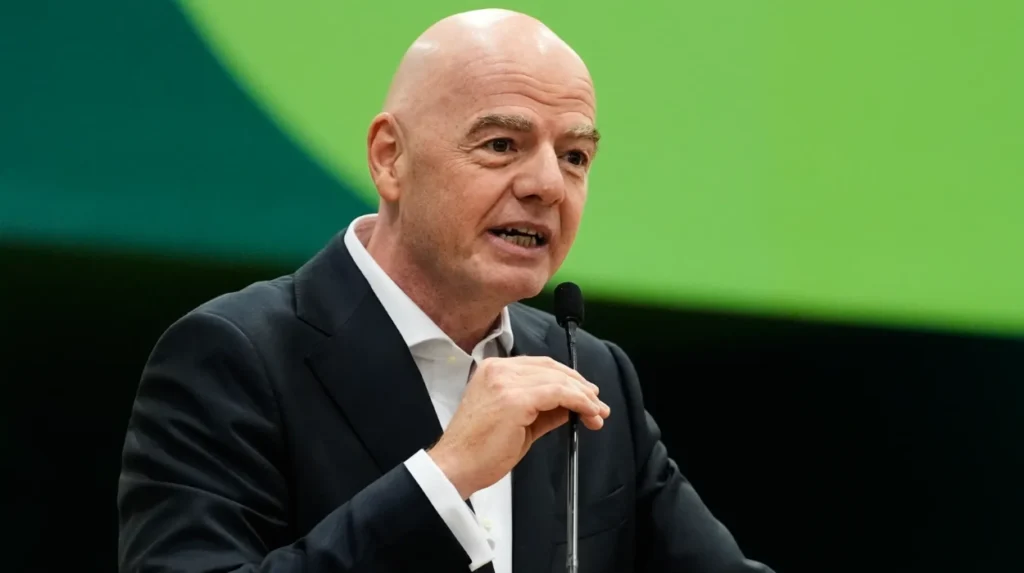
Gianni Infantino and FIFA are entering the final stretch toward the World Cup under unusual scrutiny in the United States, where concerns about access, cost, and governance have cut across party lines. The AP report shows that skepticism toward FIFA is no longer confined to traditional critics of global sport bureaucracy; it now reaches lawmakers, local officials, and other stakeholders who are preparing for a tournament that will shape not only football but also politics, commerce, and public administration across North America.
That matters because FIFA is not merely organizing matches. It is coordinating a global event whose scale places pressure on public infrastructure, pricing systems, security planning, and the credibility of sports governance itself. When such a tournament is met with bipartisan suspicion before the opening whistle, the issue is larger than public relations. It becomes a test of whether FIFA can still persuade audiences and institutions that its decisions are serving the game as well as the organization’s own interests.
Infantino’s Leadership Under Renewed Global Examination
Infantino has long presented himself as a dealmaker capable of expanding football’s reach and securing the support of political leaders in host countries. The AP reporting indicates that this approach has delivered access at the top of government, but not broad confidence beyond it. In the United States, that distinction is important. A close relationship with a president or administration can help FIFA navigate logistics and symbolism, but it does not automatically translate into trust among legislators, civic leaders, or fans who bear the practical costs of staging the event.
The skepticism now surrounding Infantino also reflects a deeper pattern in FIFA’s leadership model. The presidency has become highly personalized, while the organization’s accountability structures remain difficult for outsiders to read or influence. Supporters may argue that strong central leadership is necessary to manage a global tournament, yet critics see a system that concentrates authority while dispersing responsibility. That gap matters because the closer FIFA aligns itself with political power, the more its decisions appear shaped by relationships rather than transparent institutional standards.
Governance Questions and Transparency Issues Inside FIFA
FIFA’s governance has been a recurring source of concern because the organization operates with significant autonomy while controlling a product that generates enormous public and commercial value. Publicly reported criticism has long focused on whether decision-making is sufficiently open, whether oversight is meaningful, and whether reforms have changed the structure of power or only its presentation. Even when FIFA adopts new policies, such as human rights protocols for host committees, the central question remains how those commitments are monitored and enforced in practice.
That concern is especially relevant ahead of a tournament spread across multiple countries and dozens of host cities. The larger the event, the more FIFA depends on local governments, security agencies, venue operators, and commercial partners, but the less visible its own internal decision chain becomes to the public. This is where transparency concerns gain force: if fans, journalists, lawmakers, and civic groups cannot clearly trace how decisions were made on ticketing, security, hosting obligations, or commercial priorities, trust erodes even in the absence of a single scandal. The problem is not only misconduct; it is the opacity that allows suspicion to persist.
World Cup Commercialization and Expanding Corporate Influence
The World Cup has always been commercially important, but the modern tournament increasingly resembles a global entertainment property as much as a sporting competition. FIFA’s expansion of the event, with 48 teams and 104 matches in 2026, increases inventory for broadcasters, sponsors, hospitality buyers, and premium ticket programs, while also making the tournament more expensive and operationally complex. From a business perspective, that expansion maximizes reach and revenue. From a governance perspective, it also intensifies the perception that the event is being optimized for monetization rather than accessibility.
Commercial growth is not inherently problematic, and FIFA depends on it to finance football development worldwide. The concern is how far commercial logic now shapes the tournament’s design and public presentation. When more matches, more premium packages, and more corporate access dominate the discussion, the World Cup can appear less like a shared civic event and more like a high-value asset sold through layers of exclusivity. That shift matters because FIFA’s legitimacy has always rested on the idea that the World Cup belongs to the global public, not just to sponsors, host committees, and high-spending customers.
Ticket Pricing and Fan Accessibility Concerns Around FIFA Events
Ticket pricing has emerged as one of the clearest and most politically potent criticisms of FIFA’s approach to the tournament. The AP report notes that concerns about cost have generated bipartisan disapproval, suggesting that frustration is not simply ideological but practical: elected officials are hearing from constituents who fear being priced out of the event in their own cities. That is significant because the World Cup’s public appeal depends on the sense that ordinary fans can still participate, even when the event is highly commercialized.
Accessibility is about more than the face value of tickets. It includes the cost of travel, security, accommodation, and the wider inflation that follows a mega-event. The World Cup’s North American footprint means many supporters will face substantial expenses even before reaching the stadium. If FIFA’s pricing model emphasizes revenue capture too aggressively, the tournament risks reproducing a familiar problem in elite sport: the event is staged in public view, but the public can increasingly only watch from a distance. That tension is central to why officials and fans alike are questioning whether FIFA’s financial strategy serves football’s social role or primarily its balance sheet.
Bipartisan Criticism Highlights FIFA’s Political Challenges
The AP coverage makes clear that FIFA’s skepticism in the United States is unusual not because criticism exists, but because it is so broad-based. In a polarized political environment, it is notable when lawmakers from different parties converge around similar concerns. That convergence suggests that FIFA’s issues are not being interpreted as partisan attacks but as structural problems tied to pricing, influence, and institutional behavior. For Infantino, that is a more difficult challenge than opposition from one political camp alone.
This bipartisan discomfort also complicates FIFA’s political strategy. The organization has sought to embed itself within host-country power structures, often by cultivating relationships at the highest level of government. That approach can smooth negotiations in the short term, but it can also deepen suspicion among officials who are excluded from the inner circle or who see FIFA’s access as excessive. In that sense, political success at the top can create vulnerability below, where local and regional authorities must manage the consequences of decisions made elsewhere.
What Growing Skepticism Means for Football’s Global Future
The scrutiny facing FIFA ahead of the World Cup is not necessarily a sign that the tournament will fail, but it does suggest a narrowing margin for institutional error. The combination of political skepticism, ticket concerns, and governance questions is important because it reflects a shift in how mega-events are judged. Success is no longer measured only by stadiums filled and broadcast numbers secured. It is also measured by whether the organizing body can demonstrate fairness, transparency, and respect for the public it relies on.
For FIFA, the broader implication is that scale alone cannot substitute for trust. The organization remains central to global football, and the World Cup remains its most powerful asset. Yet the AP reporting shows that the political and public environment around the event is more demanding than before, and less willing to accept familiar assurances. If FIFA wants the tournament to be remembered for the football rather than the friction around it, it will need to show that its commercial ambitions and political alliances are compatible with a credible, accessible, and accountable global event.