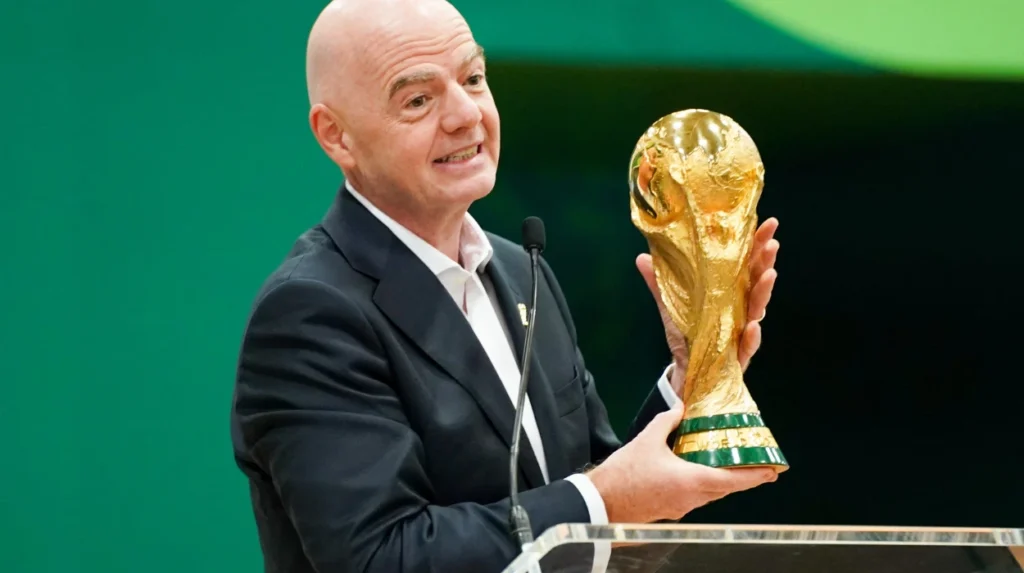
A formal complaint submitted by human rights organization FairSquare to FIFA’s Ethics Committee has introduced a new layer of scrutiny to the leadership of FIFA President Gianni Infantino. The complaint, reported by Inside World Football, raises concerns about potential breaches of FIFA’s longstanding principle of political neutrality, a cornerstone of the organization’s governance framework. At the center of the issue are alleged associations between FIFA activities and political figures, including references to former U.S. President Donald Trump, prompting renewed debate about the boundaries between global sport and political influence.
FairSquare’s submission is not positioned as a definitive finding of wrongdoing but rather as a request for formal examination under FIFA’s ethics processes. Nevertheless, the nature of the allegations, combined with the high-profile individuals referenced, has amplified attention on FIFA’s internal governance mechanisms and the consistency with which they are applied. The complaint arrives at a time when FIFA is seeking to reinforce its institutional credibility following years of reform efforts initiated after the corruption scandals of the mid-2010s.
FairSquare Allegations and Political Neutrality Concerns
FairSquare’s complaint centers on the principle enshrined in FIFA statutes that requires strict political neutrality in the conduct of football governance. According to the organization, certain actions and public engagements involving FIFA leadership may have blurred these boundaries. While the complaint itself does not assert criminal misconduct, it questions whether the perceived alignment with political figures could undermine FIFA’s claim to impartiality on the global stage.
The inclusion of Donald Trump in the broader narrative reflects concerns about FIFA’s engagement with political leadership in major host nations and strategic partners. Critics argue that visible proximity between football governance and political power risks eroding trust, particularly when such interactions appear to extend beyond ceremonial or diplomatic norms. Supporters of FIFA’s current leadership, however, may contend that engagement with heads of state is an unavoidable aspect of organizing global tournaments and securing international cooperation.
This tension underscores a recurring challenge within international sport: maintaining institutional neutrality while operating within inherently political environments. FIFA’s global footprint requires regular interaction with governments, yet its credibility depends on demonstrating that such relationships do not influence decision-making or compromise ethical standards.
Role of the FIFA Peace Prize in the Controversy
A notable element of the complaint relates to the FIFA “Peace Prize,” an initiative that has drawn scrutiny in governance terms. While FIFA has positioned the award as a symbolic effort to promote unity and dialogue through football, critics question whether its implementation and associations may carry political overtones. In particular, concerns have been raised about how recipients are selected and whether the initiative inadvertently aligns FIFA with specific political narratives or actors.
From a governance perspective, the issue is less about the existence of such an award and more about its execution. International sports bodies frequently engage in soft diplomacy through symbolic initiatives, but these efforts require clear criteria, transparency, and consistency to avoid perceptions of bias. In the absence of detailed public frameworks, even well-intentioned programs can become points of contention.
FIFA has not publicly indicated that the Peace Prize is intended to serve any political purpose, and there is no confirmed evidence that it has been used to advance specific geopolitical agendas. However, the inclusion of the initiative in FairSquare’s complaint reflects broader concerns about how symbolic gestures intersect with institutional neutrality, particularly when they involve high-level political figures or contexts.
Norway’s Support and Growing Institutional Pressure
The involvement of the Norwegian Football Federation (NFF) adds institutional weight to the complaint. By expressing support for FairSquare’s request for an ethics review, the NFF has signaled that concerns about governance and neutrality are not limited to external advocacy groups but are shared within FIFA’s own member associations.
Norway has historically positioned itself as an advocate for transparency and human rights within football governance, and its backing of the complaint is consistent with that stance. The NFF’s intervention does not imply a presumption of guilt but rather emphasizes the importance of due process and independent scrutiny. This distinction is significant, as it frames the issue as one of governance integrity rather than political confrontation.
The support of a national federation also introduces a broader dynamic within FIFA’s internal structure. Member associations play a crucial role in shaping governance norms, and their willingness to raise concerns can influence the organization’s response. If additional federations were to echo Norway’s position, the pressure on FIFA’s Ethics Committee to conduct a thorough and transparent review could intensify.
FIFA Governance and Ethics Committee Under Scrutiny
The complaint inevitably brings renewed attention to FIFA’s Ethics Committee, which has undergone substantial reform since the corruption crises that defined the organization a decade ago. The committee is designed to operate independently, with investigatory and adjudicatory chambers responsible for examining alleged breaches of the FIFA Code of Ethics.
Despite these reforms, questions about the committee’s effectiveness and independence persist. Critics argue that structural changes have not fully addressed concerns about transparency and accountability, particularly in cases involving senior leadership. The perception that decision-making may be influenced by internal dynamics or political considerations remains a challenge for FIFA.
At the same time, FIFA maintains that its governance framework has been significantly strengthened, with clearer procedures and enhanced compliance mechanisms. The handling of the FairSquare complaint will likely be viewed as a test of these claims. A transparent and methodical process could reinforce confidence in FIFA’s ethics system, while any perceived lack of rigor or openness may deepen skepticism.
Political Influence and Football’s Global Leadership Debate
The broader context of the complaint reflects an ongoing debate about the role of political influence in global football governance. Under Gianni Infantino’s presidency, FIFA has pursued an expansive strategy aimed at increasing the organization’s global reach, including the expansion of tournaments and the cultivation of relationships with a wide range of political and economic stakeholders.
This approach has yielded tangible benefits in terms of commercial growth and global visibility, but it has also raised questions about the balance between engagement and independence. The intersection of football and politics is not new, yet the scale and visibility of FIFA’s activities have amplified scrutiny of its leadership’s interactions with political figures.
Infantino has consistently defended his approach as necessary for advancing football’s global development, emphasizing the importance of collaboration with governments. From this perspective, engagement with political leaders is framed as a pragmatic requirement rather than a departure from neutrality. However, critics argue that the optics of such relationships can carry significant implications, particularly when they intersect with contentious political environments.
Transparency Challenges in Modern FIFA Administration
Transparency remains a central issue in evaluating FIFA’s governance. While the organization has introduced reforms aimed at improving accountability, including financial disclosures and compliance mechanisms, critics contend that gaps remain. The handling of high-profile ethical complaints is one area where transparency is particularly critical.
The FairSquare case highlights the importance of clear communication and procedural openness. Stakeholders, including member associations, sponsors, and fans, are likely to closely monitor how FIFA addresses the allegations. The organization’s response will not only affect perceptions of the current leadership but also shape broader assessments of its commitment to governance standards.
FIFA’s history continues to influence how such cases are interpreted. Past controversies have created a baseline of skepticism, making it more difficult for the organization to assert credibility without demonstrable transparency. At the same time, it is important to distinguish between historical issues and current processes, recognizing that reforms have altered the institutional landscape.
Timing and Reputational Implications
The timing of the complaint is particularly significant, as FIFA navigates a period of strategic expansion and heightened global visibility. With major tournaments and commercial initiatives on the horizon, the organization is seeking to project stability and integrity. Allegations related to political neutrality have the potential to complicate this narrative.
Reputational risk is a key consideration in this context. Even in the absence of confirmed wrongdoing, the existence of a formal ethics complaint can influence perceptions among stakeholders. Sponsors, broadcasters, and partner organizations may seek reassurance that governance standards are being upheld, while member associations may look for evidence of fair and independent oversight.
The involvement of external organizations such as FairSquare also reflects a broader trend in which civil society groups play an increasingly active role in scrutinizing sports governance. This dynamic adds another layer of accountability but also increases the complexity of managing reputational challenges.
The FairSquare complaint against Gianni Infantino represents more than an isolated dispute; it serves as a lens through which to examine the evolving standards of governance in global football. The issues raised—political neutrality, transparency, institutional independence, and leadership accountability—are central to FIFA’s long-term credibility.
How FIFA’s Ethics Committee addresses the complaint will likely have implications beyond the immediate case. A process that is perceived as thorough, impartial, and transparent could reinforce confidence in the organization’s governance framework. Conversely, any perception of inconsistency or opacity may deepen existing concerns.
As football continues to operate within an increasingly interconnected and politicized global environment, the challenge for FIFA will be to balance engagement with independence. The outcome of this case may help define how that balance is understood and implemented in the years ahead, shaping expectations for governance standards across international sport.