
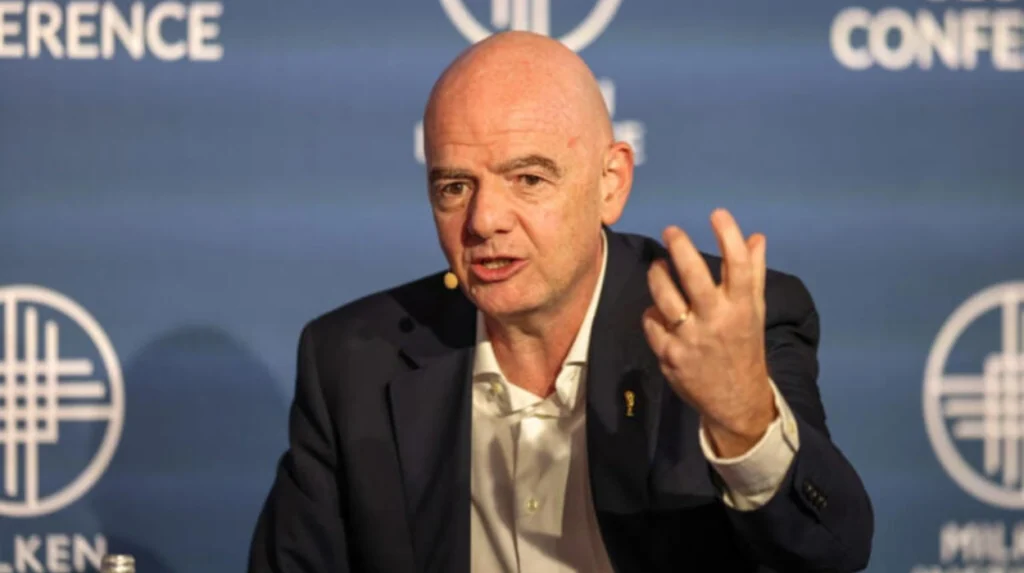
Gianni Infantino’s defense of 2026 World Cup ticket prices has become controversial because it exposes a central tension in modern football: FIFA is presenting the tournament less like a universally shared cultural event and more like a premium market product. His comparison to NCAA college football also drew scrutiny because it was widely described as inaccurate, and because it sat uneasily beside FIFA’s own rapid escalation of ticket prices for the tournament’s biggest matches.
A Controversial Defense
Infantino argued that FIFA had to price tickets at “market rates” in the United States, the host market for much of the 2026 tournament, and said that low prices would simply feed resale activity. He also claimed that ticket revenue is essential to funding football development around the world, saying those revenues are reinvested globally. That argument is not new, but the timing sharpened the backlash: FIFA had already faced criticism over unusually high face values, a dynamic-pricing model, and resale listings for the final that reached extraordinary levels.
The problem is not only the scale of the prices but the message they send. When the president of football’s global governing body frames World Cup access through the language of entertainment-market optimization, supporters hear a shift in identity. The World Cup has always been commercial, but it has also been treated as the sport’s most symbolic shared space, where access matters as much as revenue.
The NCAA Comparison Under Scrutiny
Infantino’s NCAA comparison was the most vulnerable part of his defense. Reporting after the remarks said he claimed the cheapest American college football tickets cost around $300, but ticket platforms and media analysis indicated many NCAA regular-season tickets begin at roughly $30 to $50, while even premium seats often span a broad range rather than a fixed floor. That does not mean elite college football is cheap; major rivalry games and postseason events can be expensive. But the blanket comparison to college football as a category overstated the baseline price of the sport he invoked.
That matters because analogies shape public legitimacy. If FIFA wants to justify World Cup prices by comparing them to U.S. sports, it has to compare like with like: comparable events, comparable seating inventory, comparable demand, and comparable access models. NCAA football is a fractured market with thousands of games, multiple tiers of prestige, and highly variable pricing. The World Cup, by contrast, is a concentrated global tournament whose scarcity is created by FIFA itself through limited inventory and high-stakes matches.
The Economics of Scarcity
FIFA’s rationale rests on a familiar economic argument: a product with immense demand should be priced to capture value, especially when the event is finite and the secondary market can move even higher. FIFA has emphasized demand as proof of justification, citing 150 million ticket requests for roughly 6 to 7 million tickets on sale. From a revenue-maximizing perspective, that is hard to ignore. If demand is many times larger than supply, prices will rise whether on FIFA’s platform or elsewhere.
Yet scarcity also creates ethical and cultural questions. A World Cup final listing above $7,000, with later reports of top-category prices climbing even higher, is not merely expensive in ordinary sporting terms; it is exclusionary for most households. FIFA has tried to soften that criticism by noting that a portion of group-stage tickets were offered below $300 and that a supporter entry tier priced at $60 was introduced for selected fans through federations. Still, those cheaper allocations are limited, conditional, and not representative of the market facing most buyers.
FIFA’s Dynamic Pricing Strategy
Dynamic pricing has become one of the defining features of the 2026 sales cycle, and it is central to the controversy. Under this model, prices can rise with demand over time, as they do in airlines, hotels, and some U.S. sports markets. FIFA appears to have borrowed that logic from the American business environment it is trying to address. That approach may maximize revenue, but it also makes the price a moving target, reducing predictability for fans and creating the sense that loyalty is being monetized aggressively.
The clearest criticism is not that dynamic pricing exists, but that FIFA is applying it to the World Cup without the cultural safeguards seen in many other sports contexts. In leagues and domestic competitions, fans can plan around season structures, local geography, or long-term loyalty programs. A World Cup traveler faces international flights, visas, accommodation, and now volatile ticket costs layered on top of one another. For many supporters, the result is not just higher prices but a fundamentally more precarious path to attendance.
Football’s Accessibility Debate
The debate is ultimately about who the World Cup is for. FIFA has stressed that a large share of ticket revenue is fed back into the game through development spending across its 211 member associations, and it says World Cup income is crucial to football in many countries. That claim has real institutional weight: FIFA’s own budget documents show major revenue assumptions tied to the 2026 tournament and beyond, with excess revenues intended to support development programs. In other words, FIFA is not inventing a philanthropic story from scratch; the organization’s financial model does depend on World Cup income to fund its wider ecosystem.
But the distributional question remains unresolved. FIFA has not fully demonstrated, in a way that persuades critics, how much additional ticket revenue directly reaches grassroots football in transparent, measurable form. Its claims are broad, its accounts are large, and its governance structure concentrates immense power in a single body that controls the sport’s flagship event, its commercial rights, and much of its global redistribution narrative. That leaves room for skepticism even among readers who accept that football development requires funding.
The American Sports Business Influence
The 2026 World Cup is being staged in the most commercially sophisticated sports market in the world, and FIFA seems determined to absorb at least some of that logic. The U.S. sports model normalizes premium seating, variable pricing, resale platforms, hospitality packages, and consumer segmentation by willingness to pay. Infantino’s remarks make sense only inside that framework. But the World Cup is not an ordinary North American league event; it is a once-every-four-years global tournament with deep symbolic value and a fan culture that has historically emphasized travel, atmosphere, and broad accessibility.
That is why the comparison is so revealing. FIFA is not simply adapting to U.S. business culture; it is using the U.S. market as justification for redefining the World Cup’s commercial identity. The result may be financially efficient, but it also risks narrowing the tournament’s social base. Younger supporters, lower-income fans, and traveling supporters from football countries with weaker currencies are the most exposed to that shift. For them, the cost of attending 2026 is not just high; it may be structurally prohibitive.
Governance and Accountability
The governance dimension of this dispute is impossible to ignore. FIFA’s monopoly-like control over the World Cup allows it to set prices, design sales phases, and market scarcity with little competitive constraint. That power makes the organization both the architect of the event and the sole arbiter of its affordability. When criticism mounts, FIFA can point to demand, development grants, and market logic, but it is still the entity deciding what the market is.
That concentration of authority is why ticket debates recur every cycle. The issue is not only whether a particular price point is defensible in isolation, but whether FIFA has a transparent framework for balancing revenue, accessibility, and football’s wider social role. Investigations and public scrutiny around World Cup ticketing in 2026 reflect that unresolved tension. If FIFA wants its pricing strategy to be seen as legitimate, it will need to show not only that the market will pay, but that the broader football public can see where the money goes and why the sacrifice is necessary.
A Changing World Cup
The deeper story is that the World Cup is changing shape. FIFA is acting like a global entertainment corporation that believes it can monetize peak scarcity while still claiming the moral authority of a development body. Those two identities are not necessarily incompatible, but they are increasingly difficult to reconcile when final tickets cost several thousand dollars and the president invokes college football to make the case.
That is why Infantino’s comments landed so badly. They were meant to sound pragmatic, even inevitable, but they instead highlighted how far the tournament has moved from its traditional fan-first mythology. FIFA may well be able to sell every seat and still argue that the revenues help the game worldwide. The harder question is whether the World Cup becomes less credible as football’s common property if too many ordinary supporters are priced out of the stands.