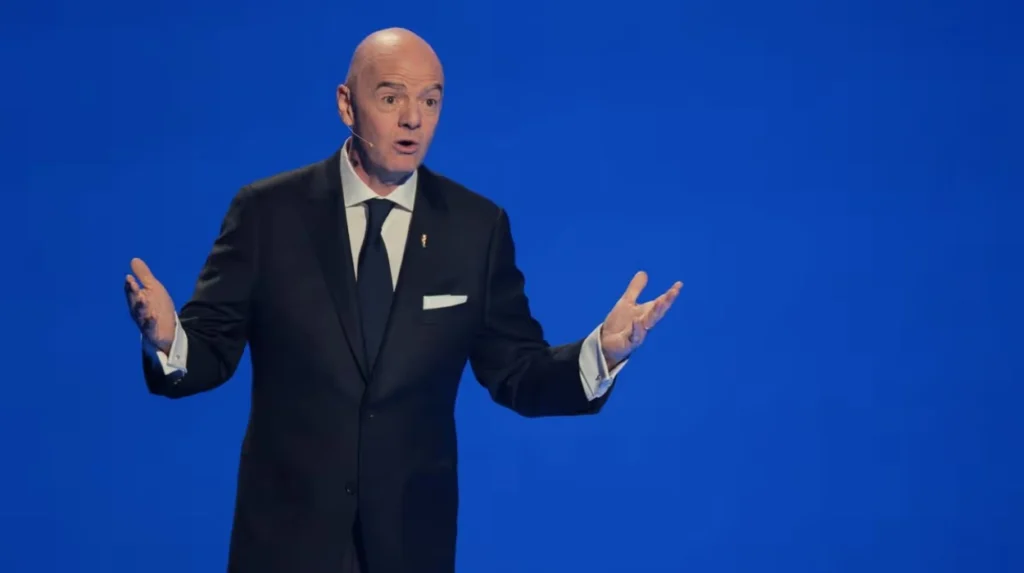
Gianni Infantino’s speech at the 2026 World Cup draw was designed as a celebration, not a political intervention. FIFA framed the event as a high-profile, entertainment-heavy showcase for the tournament, with Infantino presenting the draw as part spectacle, part global civic ritual. Yet the same staging that was intended to project scale and confidence also created the conditions for scrutiny, because once a FIFA president speaks in a politically charged American setting, every line is likely to be read through a wider geopolitical lens.
The controversy that followed was less about a single sentence than about the atmosphere around it. Infantino’s language was grandiose and carefully promotional, but that style has long been central to his public persona, and it often blurs the line between institutional messaging and personal performance. In a neutral setting, such rhetoric might register as routine FIFA hyperbole. In the context of a World Cup co-hosted by the United States, however, it was enough to trigger a wave of suspicion among online audiences already primed to connect FIFA’s leadership to American political power.
Social Media Interpretation and the ICE Narrative
The online backlash followed a familiar digital pattern: a brief, ambiguous moment became a vessel for broader concerns about immigration enforcement, state power, and FIFA’s relationship with the Trump administration. Some posts and comments linked the speech informally and speculatively to ICE, even though the draw itself was a ceremonial event and not an operational policy announcement. That distinction matters, but it is also precisely the kind of nuance that social media tends to flatten.
The ICE narrative did not emerge in a vacuum. FIFA had already faced public pressure over the role of U.S. immigration enforcement during the tournament, and reports later suggested that senior FIFA figures had discussed asking President Trump for a moratorium on ICE activity during the World Cup. That backdrop made it easier for audiences to interpret any Infantino-Trump interaction, or any unusually warm public language, as evidence of something more substantive than ceremonial diplomacy. In that sense, the backlash was not simply misreading; it was a digital condensation of pre-existing anxieties.
FIFA’s Communication Style Under Gianni Infantino
Infantino’s communication style has been one of the defining features of his presidency. He tends to speak in sweeping, emotionally expansive terms that aim to elevate FIFA above ordinary sports administration and into the realm of global mission. That approach can be effective in front of cameras, but it also creates risk because it rarely sounds bureaucratically precise. When an institution that claims neutrality communicates in a theatrical register, audiences begin to wonder whether the performance is covering for something less transparent.
This is where FIFA’s problem extends beyond the draw itself. The organization often communicates through spectacle, surprise, and managed imagery rather than detailed explanation. The result is a persistent gap between official messaging and public interpretation, especially when leadership appears unusually close to political figures in host countries. Even when FIFA’s stated goal is simply to stage a smooth event, its messaging style can make the organization look as though it is shaping perception rather than inviting scrutiny.
The Question of Neutrality in Global Football Governance
FIFA’s political neutrality has always been more aspirational than absolute, but under Infantino that tension has become more visible. The organization has repeatedly emphasized that it is neutral in political matters, yet critics have pointed to public gestures and remarks that appear to complicate that claim. The result is not necessarily proof of partisan intent, but it is evidence that FIFA’s neutrality is increasingly seen as selective, strategic, and dependent on context.
That perception matters because FIFA’s authority depends on trust from many constituencies at once: member associations, host governments, players, sponsors, broadcasters, and fans. When a FIFA president appears overly comfortable with a powerful political leader, the organization may believe it is protecting the tournament’s practical interests. Critics, however, may see the same behavior as a compromise of institutional distance. In modern football governance, neutrality is not just a policy position; it is a credibility asset. Once that asset erodes, every public appearance becomes a test.
Transparency Concerns and Institutional Trust in FIFA
The backlash around the draw also revived a broader criticism that has followed FIFA for years: the perception that it is stronger at image management than at accountability. Reports around the 2026 cycle have described internal discussions about ICE, possible approaches to the White House, and the optics of joint messaging, but much of that debate has reached the public only through leaks and secondary reporting rather than clear institutional explanation. That silence leaves room for speculation, and speculation thrives where transparency is limited.
This is not a new issue for FIFA. The organization has long faced criticism over governance opacity, decision-making, and the distance between its public slogans and its operational reality. In that context, even routine ceremonial language can be interpreted as part of a larger pattern of image-first governance. The problem is not only what FIFA says, but what it declines to clarify when controversy begins to build.
Political Context of the 2026 World Cup Host Nations
The 2026 World Cup is unusual because it is being staged across Canada, Mexico, and the United States, with the U.S. carrying particular political weight because of its immigration policy environment and security apparatus. FIFA has publicly said that fans will be welcome and that visa processes should be smooth, but the organization has also acknowledged the need to coordinate closely with host governments. That dual message is practical, yet it also exposes FIFA to criticism that it is relying on political assurances while remaining publicly vague about the risks.
The United States is not simply another host nation in this cycle. It is the center of the tournament’s commercial and political gravity, and that makes any discussion of crowd control, travel access, or enforcement policy inseparable from broader debates about national identity and governance. For some observers, that means FIFA should be more forceful in defending the openness of the event. For others, it means FIFA is trapped between its need for cooperation and its desire to appear above politics. Either way, the organization cannot fully escape the context it has chosen.
Spectacle Versus Governance
The draw’s entertainment framing was meant to signal grandeur, but it also illustrated a recurring FIFA dilemma: the more the organization leans into spectacle, the harder it becomes to distinguish event branding from governance behavior. Musical performances, celebrity hosts, and patriotic choreography can give the impression of a confident global institution, yet they also shift attention away from the harder questions surrounding tournament administration. In that sense, spectacle works as both a strength and a shield.
This tension matters because modern football administration increasingly overlaps with geopolitics. Tournament hosts are no longer just logistical partners; they are part of a diplomatic ecosystem in which FIFA must negotiate immigration, policing, media freedom, and reputational risk. The organization’s instinct has often been to resolve those tensions through polished presentation and controlled messaging. But the more complex the backdrop becomes, the less convincing that approach appears to critics.
Public Perception and Institutional Messaging
The gap between FIFA’s official line and public perception is now one of its central governance problems. Infantino may have intended a celebratory tone, but many online viewers saw an administrator too comfortable with political theatre and too aligned with a host-country power structure already under scrutiny. That does not prove the backlash was fully grounded in the speech itself. It does show that FIFA has spent years building a communications environment in which mistrust is a default response.
The ICE-linked reaction is best understood as a symptom of that trust deficit. Some of the backlash was undoubtedly exaggerated, and some of it reflected the speed and distortion of social media. But exaggeration alone does not create controversy at scale. It requires a pre-existing belief that FIFA is evasive, politically flexible when convenient, and more interested in controlling optics than answering uncomfortable questions. On that point, the online reaction was less an aberration than a reflection of longstanding concerns.
What made the draw controversy resonate was not a single speech, but the convergence of style, context, and memory. Infantino’s performance at the event, FIFA’s history of selective messaging, and the broader political sensitivity of hosting a World Cup in the United States combined to produce a backlash that was partly factual, partly interpretive, and partly algorithmic. That combination is increasingly typical in elite football governance, where every ceremony carries the potential to become a proxy fight over power, neutrality, and trust.
The most useful reading of the episode is not that FIFA was caught in a scandal of its own making, nor that social media invented one from nothing. It is that the organization’s communication habits make it unusually vulnerable to this kind of interpretation. In an era when football governance is scrutinized through political and digital frames at the same time, FIFA can no longer assume that spectacle will insulate it from criticism. In many cases, spectacle now creates the criticism.