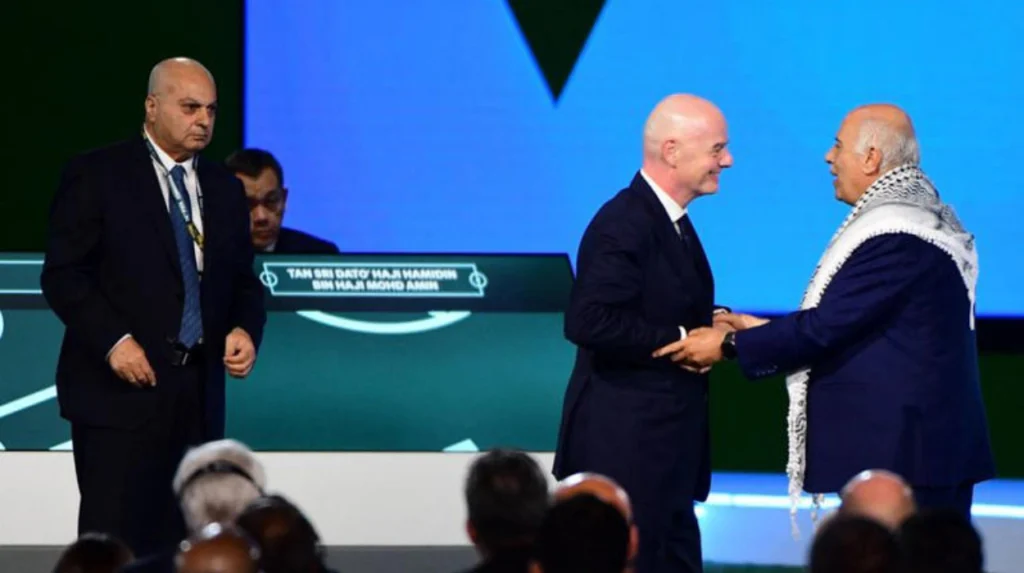
At a recent FIFA-organized event, president Gianni Infantino facilitated an interaction between representatives of the Israeli and Palestinian football associations that quickly became a focal point of global media attention. The moment, framed as a symbolic gesture of unity and coexistence, involved an apparent attempt to encourage a public display of mutual acknowledgment between the two officials. The interaction, however, unfolded with visible hesitation, resulting in what many observers described as an awkward or forced exchange.
While the event itself was not unprecedented in its intent, FIFA has historically used such occasions to project football as a unifying force, the specific geopolitical sensitivities surrounding Israel and Palestine elevated the stakes. What may have been conceived as a routine diplomatic gesture within sport instead became a widely scrutinized episode, raising broader questions about FIFA’s role in facilitating symbolic interactions within ongoing conflicts.
FIFA’s Longstanding Position on Political Neutrality in Football
FIFA has consistently maintained that football should remain politically neutral, emphasizing its role as a global unifier rather than a platform for political expression. This principle, codified in its statutes, has guided its responses to a wide range of geopolitical issues, from national disputes to athlete activism. However, the practical application of neutrality has often been uneven, reflecting both institutional priorities and external pressures.
Historically, FIFA has engaged in selective intervention when political issues intersect directly with football governance, such as disputes over national federations or territorial recognition. In cases like apartheid-era South Africa or more recent tensions involving national federations in conflict zones, FIFA has demonstrated a willingness to act, though often cautiously and incrementally.
The incident involving Israeli and Palestinian officials illustrates the inherent tension in FIFA’s neutrality doctrine. By orchestrating a symbolic interaction, the organization implicitly stepped into a politically charged space, even as it continued to frame its actions within the language of unity and sport.
Symbolism in Global Sport: When Gestures Become Political Statements
Symbolic gestures in sport occupy a complex space between diplomacy and performance. Handshakes, joint appearances, and shared ceremonies are often deployed to signal reconciliation or mutual respect, but their meaning is rarely fixed. Instead, such gestures are interpreted through broader political contexts and media narratives.
In this case, the attempted interaction carried multiple layers of symbolism. For FIFA, it represented an affirmation of football’s potential to transcend conflict. For observers, however, it raised questions about authenticity and agency. The visible discomfort of the participants suggested that the gesture may not have been entirely voluntary, complicating its intended message.
Symbolic acts are particularly fraught in active conflict situations, where they can be perceived as superficial or misaligned with on-the-ground realities. Rather than fostering understanding, they risk being interpreted as performative or insensitive, especially when they occur without substantive dialogue or policy engagement.
The Limits of Sports Diplomacy in Active Geopolitical Conflicts
Sports diplomacy has long been promoted as a tool for bridging divides, but its effectiveness is contingent on context. In situations of entrenched conflict, where political, territorial, and humanitarian issues remain unresolved, the capacity of sport to facilitate meaningful dialogue is inherently limited.
The FIFA incident underscores these limitations. While the organization sought to create a moment of symbolic unity, the absence of a broader framework for engagement reduced the interaction to a brief and highly visible gesture. Without sustained initiatives or institutional backing, such moments are unlikely to produce lasting impact.
Moreover, the asymmetry of the Israeli-Palestinian context introduces additional complexities. Differences in political status, mobility, and institutional capacity affect how each side engages with international sporting bodies. These disparities can influence both the perception and the substance of any symbolic interaction, further complicating FIFA’s role.
Power Dynamics and Representation in Staged Sporting Interactions
The staging of symbolic interactions within global sporting events often reflects underlying power dynamics. FIFA, as the governing body, exercises significant control over the format and presentation of such moments, shaping both the participants’ roles and the audience’s perception.
In this instance, the presence of Infantino as an intermediary figure highlighted FIFA’s authority in orchestrating the exchange. However, it also raised questions about consent and representation. To what extent were the officials able to navigate the interaction on their own terms, and how did the institutional setting influence their responses?
The dynamics of representation are particularly salient in conflicts where narratives are contested and highly politicized. By bringing the two officials together in a controlled environment, FIFA effectively framed the interaction as a bilateral engagement, potentially overlooking the broader complexities of the conflict and the diverse perspectives within each community.
Media Framing and the Construction of “Cringe” Narratives
Media coverage of the incident played a significant role in shaping its global reception. Headlines frequently emphasized the awkwardness of the interaction, using terms such as “cringe-worthy” to capture audience attention. This framing, while effective in generating engagement, also simplified the event into a moment of spectacle.
The use of such language reflects broader trends in sports media, where complex geopolitical issues are often distilled into easily digestible narratives. By focusing on the perceived discomfort of the participants, coverage tended to prioritize the visual and emotional aspects of the interaction over its structural and institutional implications.
This approach has implications for public understanding. It shifts attention away from FIFA’s strategic decisions and the broader context of sports diplomacy, instead centering the narrative on individual behavior. As a result, the incident becomes less about institutional analysis and more about momentary perception.
Institutional Reputation and FIFA’s Communication Strategy
FIFA’s response to the incident provides insight into its broader communication strategy. The organization has increasingly positioned itself as a promoter of global unity, emphasizing initiatives that highlight football’s inclusive potential. However, this messaging must be balanced against the realities of political sensitivity and public scrutiny.
In this case, FIFA did not significantly expand on the rationale behind the interaction, allowing media narratives to fill the interpretive space. This absence of detailed explanation may reflect a strategic choice to avoid further politicization, but it also limited the organization’s ability to shape the discourse.
Institutional reputation is closely tied to how such moments are managed. For FIFA, which has faced ongoing criticism over governance and decision-making, the handling of politically sensitive interactions carries additional weight. The incident thus becomes part of a broader narrative about the organization’s role and credibility in global sport.
The Role of Athletes and Officials as Political Symbols
Athletes and officials often occupy dual roles as both sporting representatives and symbolic figures. In international contexts, their actions are frequently interpreted through political lenses, regardless of their personal intentions.
The Israeli and Palestinian officials involved in the incident were placed in a position where their participation carried symbolic significance beyond football. Their responses, whether perceived as cooperative or reluctant, were subject to interpretation by diverse audiences with differing expectations.
This dynamic raises questions about agency and responsibility. While FIFA may frame such interactions as opportunities for unity, the individuals involved bear the immediate consequences of public scrutiny. Their roles as symbols are not entirely self-determined, but shaped by institutional decisions and media framing.
Public Perception, Social Media Amplification, and Narrative Polarization
The rapid circulation of the incident across social media platforms amplified its visibility and intensified its interpretation. Short video clips and headlines were shared widely, often accompanied by commentary that reflected polarized perspectives.
Social media environments tend to favor clear, emotionally resonant narratives, which can reinforce simplified interpretations of complex events. In this context, the incident was variously framed as a failed diplomatic gesture, an example of institutional overreach, or a reflection of broader geopolitical tensions.
The amplification process also affects how such events are remembered. Rather than being understood as part of a larger institutional strategy, the interaction becomes a standalone moment, detached from its broader context. This fragmentation can limit more nuanced analysis and contribute to entrenched perceptions.
The FIFA incident involving Israeli and Palestinian officials illustrates the challenges of navigating political neutrality in contemporary sport. While the organization seeks to position football as a unifying force, its actions inevitably intersect with complex geopolitical realities.
Symbolic gestures, while potentially meaningful, carry inherent risks when deployed in sensitive contexts. Their interpretation depends not only on intent but on execution, context, and media framing. Without careful consideration, such moments can generate ambiguity rather than clarity.
For FIFA, the incident underscores the importance of aligning its messaging with a deeper understanding of the environments in which it operates. As global sport continues to intersect with political and social issues, the balance between neutrality and engagement will remain a central challenge, requiring both strategic foresight and institutional accountability.