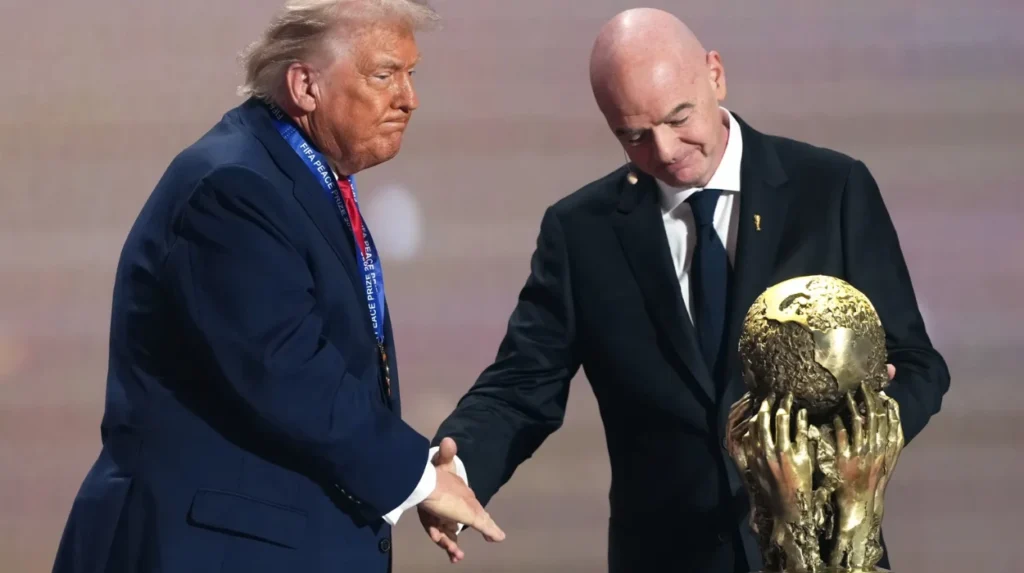
FIFA, the international governing body for football, has encountered significant scrutiny in the lead-up to the 2026 World Cup, hosted across the United States, Canada, and Mexico, over its decision to award a newly established “FIFA Peace Prize” to U.S. President Donald Trump. The controversy erupted publicly during the World Cup draw ceremony in December 2025 in Washington, D.C., where FIFA President Gianni Infantino presented the inaugural prize to Trump, complete with a medal and laudatory remarks framing it as recognition for diplomatic efforts fostering dialogue and stability. This event, occurring just months after Trump’s inauguration following his reelection, amplified perceptions of alignment between FIFA’s leadership and the U.S. political sphere, particularly given Trump’s vocal aspirations for a Nobel Peace Prize. Critics, including human rights organizations and football association leaders, quickly mobilized, accusing FIFA of breaching its own statutes on political neutrality by intertwining sport with high-profile political symbolism. The timing, mere weeks before the tournament’s kickoff in June 2026, intensified the debate, as stakeholders questioned whether such an award compromised football’s role as a unifying global force amid ongoing U.S. policies on immigration, deportations, and international relations. Reports from outlets like Al Jazeera highlighted calls from figures such as Lise Klaveness, President of the Norwegian Football Association, for FIFA to scrap the prize and defer peace recognitions to established bodies like the Nobel Institute, underscoring the debate’s roots in procedural opacity and symbolic overreach.
FIFA’s Historical Position on Political Neutrality in Global Football
FIFA has long codified political neutrality as a cornerstone of its governance framework, enshrined in Article 3 of its Statutes, which explicitly prohibits any political, racial, or religious interference in the sport and mandates that member associations remain autonomous from external influences. This principle traces back to the organization’s founding ethos post-World War II, when football was positioned as a vehicle for international reconciliation, exemplified by the IOC’s similar apolitical stance in the Olympic Charter. Throughout its history, FIFA has enforced this neutrality variably: it suspended the Yugoslavian federation in 1992 over ethnic conflicts during the Balkans wars and barred teams from competing under certain national flags during Cold War tensions. Under Infantino’s presidency since 2016, however, the organization has faced accusations of selective application, particularly in host nation selections like Qatar 2022, where labor rights issues intersected with geopolitical interests. The statutes also require presidents to uphold ethical standards, including avoiding actions that could politicize the sport, a benchmark now invoked by complainants like the nonprofit FairSquare, which filed ethics probes alleging Infantino’s Trump interactions—ranging from White House meetings to joint appearances—violate these rules. FIFA’s official communications have consistently reiterated this neutrality, as seen in statements ahead of the 2026 draw emphasizing human rights commitments, yet the Peace Prize introduction appears to test the boundaries of this historical commitment.
The Nature of the Allegation: Politicisation of Sport Through Symbolic Awards
At its core, the allegation posits that FIFA’s Peace Prize represents a deliberate politicization of sport by leveraging symbolic awards to curry favor with powerful political figures, thereby undermining football’s purported universality. The prize, announced by Infantino and awarded to Trump amid fanfare at the World Cup draw, was accompanied by a video montage praising the recipient’s role in de-escalating global tensions, echoing narratives of Trump’s self-promoted diplomatic achievements. Critics argue this elevates personal political agendas into FIFA’s domain, transforming a ceremonial moment into an endorsement that implicates the organization in U.S. domestic and foreign policy optics. The opaque nomination and selection process—lacking disclosed criteria or independent oversight—further fuels claims of instrumentalization, with activists from Human Rights Watch and the NAACP demanding transparency on how Trump emerged as the first honoree. Proponents of the criticism frame the award not as genuine peace advocacy but as a consolation akin to a “participation trophy,” given Trump’s public Nobel pursuits, thus diluting sport’s integrity as a neutral arena. This symbolic act, set against the backdrop of U.S. hosting duties, raises questions about whether awards ostensibly for peace inadvertently signal FIFA’s deference to host governments.
Criticism From Stakeholders and Concerns Over Institutional Integrity
Stakeholders spanning football administrators, players, and advocacy groups have voiced apprehensions that the prize erodes FIFA’s institutional integrity, potentially setting precedents for future political maneuvering. Lise Klaveness, a UEFA Executive Committee member, advocated for external handling of such awards to preserve FIFA’s focus, while Australian player Jackson Irvine decried it as a mockery of FIFA’s Human Rights Policy. Human rights coalitions like Sport & Rights Alliance and Dignity 2026 held press conferences protesting the award amid U.S. policies on migrant deportations and surveillance, warning of risks to fans and workers at the tournament. FairSquare’s formal complaint to FIFA’s Ethics Committee accuses Infantino of direct rule breaches through public endorsements and social media activity supporting Trump. These voices collectively express fears that associating with controversial figures compromises football’s moral authority, especially as the 2026 event expands to 48 teams and 104 matches across 16 North American cities, amplifying its global visibility. Norwegian and other European federations are preparing formal inquiries, signaling broader institutional pressure.
FIFA’s Possible Justifications and Institutional Perspective
From FIFA’s vantage, the Peace Prize could be defended as an extension of its mission to promote peace and development through football, aligning with initiatives like Football for Peace and past recognitions of humanitarian figures. Infantino’s meetings with Trump, including the establishment of a U.S. task force for tournament preparations generating an estimated $40 billion economic impact and 200,000 jobs, underscore pragmatic collaboration with host governments—a necessity for mega-events. Official statements portray the award as honoring contributions to stability, potentially referencing Trump’s role in events like the Egypt peace summit on Gaza, without explicit political endorsement. FIFA Vice-President Victor Montagliani has dismissed concerns as exaggerated, emphasizing that robust government ties ensure security and fan access, with politics fading once matches commence. The lack of an official response to recent criticisms may reflect confidence in internal ethics processes or a strategic silence to avoid escalation, positioning the prize within FIFA’s broader diplomacy rather than a neutrality violation.
The Role of Politics in Modern Global Sporting Events
Modern mega-events like the World Cup inexorably intersect with politics, as host selections, security, and logistics demand state involvement, often exposing structural tensions between sport’s ideals and realpolitik. Governments leverage tournaments for soft power—Russia 2018 burnished national image amid sanctions, while Qatar 2022 advanced Gulf diplomacy—mirroring FIFA’s need for political buy-in. The 2026 edition, spanning three nations, navigates U.S. immigration strictures affecting qualifiers like Iran, alongside Trump’s direct oversight via executive task force. Such entanglements challenge neutrality claims, as funding, infrastructure, and visa policies politicize proceedings. Yet, football’s global appeal derives partly from transcending borders, prompting FIFA’s statutes to safeguard against overt interference while pragmatically engaging leaders.
Media Framing and Its Influence on Public Perception of the Issue
Media coverage has shaped perceptions by amplifying activist critiques and framing the prize as cronyism, with outlets like BBC and Al Jazeera emphasizing ethics probes and player dissent, while conservative-leaning narratives might recast it as diplomatic courtesy. Sensational headlines—”Trump Prize Politicizes World Cup”—heighten scrutiny, influencing public discourse on platforms like YouTube where protest videos garner views. This framing risks polarizing fans, yet balanced reporting, such as CNN’s contextualization of Infantino-Trump ties, provides nuance. Ultimately, media’s role underscores how narratives construct reality around sport-political nexuses.
Comparative Examples of Political Controversies in International Sport
Historical parallels abound: the 1978 World Cup in Argentina under military junta drew boycotts over human rights abuses; 1936 Berlin Olympics served Nazi propaganda; and South Africa 2010 faced FIFA criticism for apartheid legacies despite post-sanctions hosting. More recently, Beijing 2022 Winter Olympics faced genocide allegations in Xinjiang, prompting diplomatic boycotts. These cases reveal recurring patterns where hosts’ politics infiltrate sport, testing governing bodies’ neutrality. Unlike those, the 2026 controversy centers on an award rather than hosting flaws, yet echoes concerns over symbolism legitimizing regimes.
Implications for the 2026 World Cup and Future FIFA Governance
The fallout could shadow the 2026 tournament with boycott threats from European quarters and ethics rulings impacting Infantino’s tenure, potentially eroding stakeholder trust. Governance reforms might mandate clearer award protocols or independent oversight, fortifying neutrality amid expanding commercial stakes. For FIFA, resolving inquiries transparently is crucial to refocus on the event’s inclusivity.
Can Global Sport Ever Be Fully Politically Neutral?
Achieving absolute neutrality remains elusive, as sport mirrors societal power dynamics—economic dependencies on states and corporations inherently politicize it. While statutes aspire to insulation, practical imperatives like security and funding necessitate engagement. The tension persists as a dialectic: sport’s universalism thrives on managed, not eradicated, political interfaces.