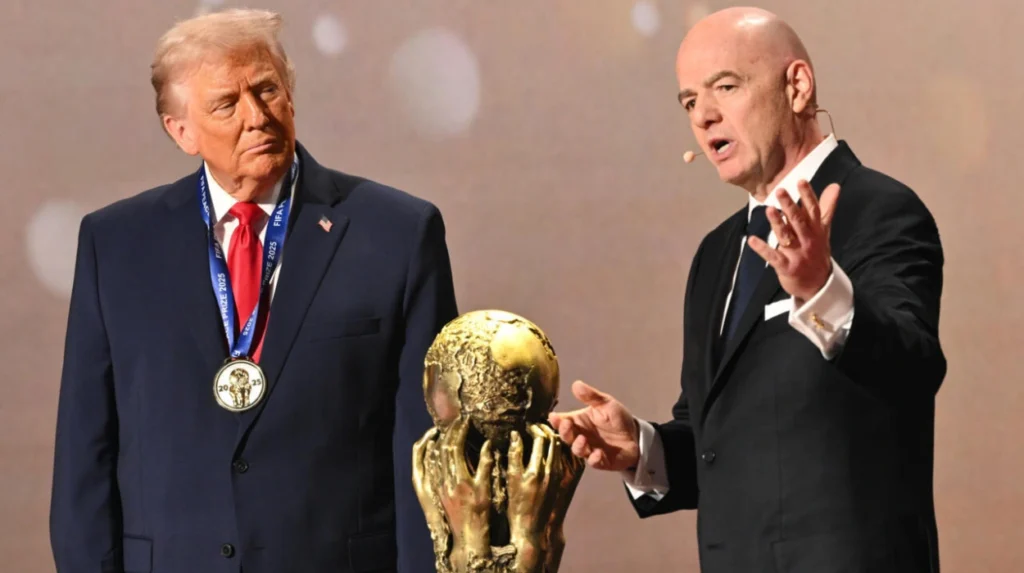
When FIFA handed Donald Trump the inaugural FIFA Peace Prize in December 2025, the optics were meant to be immaculate: a golden trophy, a medal, and a certificate presented by Gianni Infantino as the president spoke of saving “tens of millions of lives” and stopping wars before they began. Instead, within weeks, the award has become a symbol of how far football’s governing body is willing to stretch the word “peace” to maintain political favour and protect its commercial interests.
The honour was billed as a recognition of “exceptional and extraordinary actions for peace” by individuals who have “united people across the world,” language that now rings hollow as the Trump administration leans into a more overtly militarised foreign policy. The dissonance between the stated purpose of the prize and the conduct of its first recipient has triggered a fierce backlash that FIFA seems both unwilling and unprepared to confront.
From Peace Rhetoric to Military Actions
Barely a month after accepting the award, Trump announced that US forces had captured Venezuelan president Nicolás Maduro and his wife Cilia Flores in a covert operation, an act widely condemned as a destabilising intervention rather than a peace-building measure. The move undermines the notion that the prize honours restraint, dialogue, or conflict de-escalation—traditional hallmarks of genuine peace initiatives.
The Venezuelan operation is not an isolated episode but part of a growing pattern of aggressive posturing that sits uneasily with any claim to moral authority. Critics argue that by keeping Trump on a pedestal, FIFA is tacitly normalising a model of “peace” enforced at gunpoint, where regime change and military coercion can be spun as humanitarian achievements.
Threats, Tariffs, and the Greenland Gambit
The controversy has deepened as Trump has issued threats of possible military action against Iran, Mexico, Colombia, and even Greenland, a territory he insists the United States “needs” for security reasons. Demanding that Denmark hand over Greenland, and then tying punitive tariffs on the UK and other allies to a potential deal for territorial transfer, pushes the dispute far beyond the realm of traditional diplomacy.
European allies have pushed back strongly, with UK Prime Minister Sir Keir Starmer describing the Greenland plans as “completely wrong,” underscoring how isolated Washington’s stance appears even among partners. These escalatory tactics—linking trade pressure to quasi-colonial territorial ambitions—highlight the absurdity of presenting Trump as a unifying force for global peace and reinforce accusations that FIFA is endorsing power politics over principles.
FIFA’s Defensive Posture and Political Calculus
Faced with mounting criticism and calls for Trump to be stripped of the FIFA Peace Prize, the organisation has chosen not contrition but defiance. In a statement, FIFA “strongly supports its annual peace prize” and notes approvingly that Venezuelan opposition leader and 2025 Nobel Peace Prize recipient María Corina Machado has given her Nobel medal to Trump, an attempt to borrow legitimacy from another contested decision.
FIFA boasts of its “strong relations with President Trump” and fellow co-host leaders in Canada and Mexico, crediting this for initiatives such as the White House Task Force for the 2026 World Cup. The message is unmistakable: the peace prize is as much about access, logistics, and high-level cooperation around the tournament as it is about any ethical stance on war, sovereignty, or human rights.
Embarrassment Inside FIFA and Damage to the Game
Despite the official line, reporting indicates a growing sense of embarrassment within FIFA about the decision to honour Trump, suggesting internal recognition that the award is politically and morally compromised. Officials are said to be increasingly uncomfortable with the gap between the prize’s lofty mission of “peace and unity” and the reality of its recipient’s threats and interventions.
For the wider football community, the fallout risks further eroding trust in an organisation already burdened by years of corruption scandals and credibility crises. By clinging to a contentious award in the face of escalating militarism, FIFA is inviting questions about whether its values are genuinely universal or merely transactional, contingent on who can deliver stadiums, sponsorships, and geopolitical clout.