Saudi Crown Prince Mohammed bin Salman’s high‑profile meetings with Sudanese army chief Abdel Fattah al‑Burhan are framed as efforts to “restore stability”, yet Sudan’s conflict continues to deepen amid failed truces and mass displacement, raising doubts about the effectiveness and transparency of Saudi diplomacy. These developments intensify scrutiny of Saudi Arabia’s 2034 FIFA World Cup bid, as stakeholders question whether its governance, rights record and conflict‑mediation practices align with the sport’s own human‑rights and ethical‑hosting commitments.
Saudi Crown Prince Mohammed bin Salman’s recent engagement with Sudan’s military leader Abdel Fattah al‑Burhan, presented as a push towards “moderate positions” and conflict resolution, illustrates Riyadh’s effort to project itself as a regional peacemaker at the same time as it seeks to host the 2034 World Cup. While official statements highlight “security and stability”, the escalation of violence in Sudan, the collapse of ceasefires and questions over regional rivalries cast a shadow over the credibility of this diplomacy and raise concerns about whether Saudi Arabia’s broader governance environment matches global sports‑governance standards.
Saudi–Sudan talks framed as a push for stability
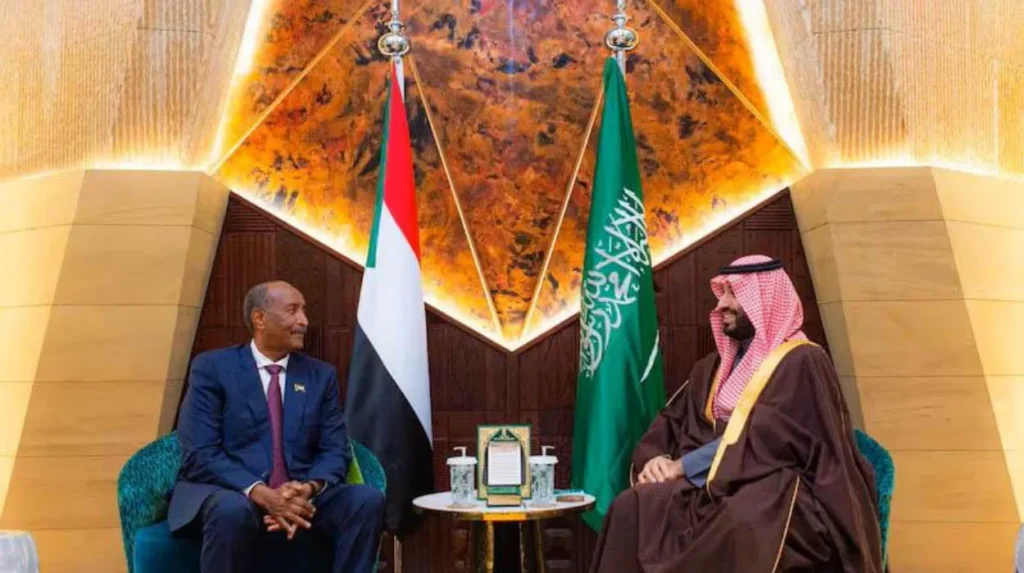
According to Anadolu Agency, citing the Saudi Press Agency, Crown Prince Mohammed bin Salman met Abdel Fattah al‑Burhan in Riyadh to discuss “efforts to achieve security and stability” in Sudan as clashes between the Sudanese Armed Forces (SAF) and the Rapid Support Forces (RSF) continue.
Anadolu reports that Sudanese Foreign Ministry Undersecretary Muawiya Osman described al‑Burhan’s trip as “a successful friendly visit”, during which the two leaders explored ways to develop relations “through a sustainable strategic partnership” under the guidance of their respective leaderships.
Radio Dabanga similarly reports that Mohammed bin Salman received Abdel Fattah al‑Burhan at Al‑Yamamah Palace in Riyadh, with senior Saudi officials including Defence Minister Prince Khalid bin Salman and Foreign Minister Prince Faisal bin Farhan present at the talks.
Radio Dabanga notes that Abdel Fattah al‑Burhan praised Mohammed bin Salman as “the voice of truth and the voice of the region”, adding that Sudanese affected by the war “look with satisfaction and appreciation” at the crown prince’s efforts and view Saudi‑sponsored initiatives as “an opportunity to spare the country destruction”.
Strategic partnership and the Quad framework
The North Africa Post reports that Abdel Fattah al‑Burhan’s one‑day visit to Riyadh in mid‑December was intended to deepen bilateral relations and advance a “sustainable strategic partnership”, including the establishment of a Strategic Cooperation Council between Sudan and Saudi Arabia.
The same outlet quotes Ambassador Muawia Osman as saying the talks focused on ending the war and achieving peace and stability in Sudan, with Abdel Fattah al‑Burhan expressing gratitude for Saudi support and acknowledging Mohammed bin Salman’s wider regional vision.
Anadolu Agency points out that Saudi Arabia is a member of the international Quad mechanism with the United States, Egypt and the United Arab Emirates, which has floated a proposal for a three‑month humanitarian truce as the starting point for a permanent ceasefire and a nine‑month transition to an independent civilian government.
This framework situates Riyadh at the centre of diplomatic efforts to shape Sudan’s political trajectory, reinforcing its image as a venue where key regional and international actors converge.
Civil‑society appeals and stalled ceasefires
Radio Dabanga reports that Sudanese civil‑society groups, including the Sudanese Group for the Defence of Rights and Freedoms and the Darfur Lawyers Authority, submitted a memorandum to Mohammed bin Salman calling for urgent Saudi action to stop the war and to revitalise the Jeddah platform as the main framework for peace negotiations.
The groups reportedly welcomed the Saudi‑US‑sponsored Jeddah talks launched in May 2023, which produced commitments on protecting civilians and a short humanitarian truce, and urged an immediate comprehensive ceasefire, an end to aerial bombardment of cities and the creation of a joint regional‑international mechanism to monitor any truce.
Yet analysis by Responsible Statecraft and other observers records that since fighting erupted between the SAF and RSF in April 2023, the conflict has escalated severely, resulting in thousands of deaths and millions displaced, while successive ceasefire attempts have broken down.
These outcomes raise concerns among governance and human‑rights experts about the effectiveness and transparency of Sudan‑related diplomacy hosted in Saudi Arabia, and about whether such processes sufficiently include Sudanese civilian actors as opposed to being dominated by military and regional elites.
From peacemaker narrative to image management
In an analysis for DAWN, researcher Joey Shea argues that Saudi Arabia has expanded beyond “sportswashing” into what she describes as “diplomacywashing”, using high‑profile diplomatic events to bolster its image as a global peacemaker.
The DAWN article notes that Saudi Arabia has hosted talks on conflicts including Ukraine and Sudan that have generated headlines about Riyadh “emerging as a diplomatic broker”, even in cases where its substantive role in negotiations appears limited.
According to DAWN, for Mohammed bin Salman and his entourage, such events serve a powerful public‑relations function: they portray Saudi leadership as constructive international problem‑solvers rather than as rulers facing persistent criticism over human‑rights abuses, including the killing of journalist Jamal Khashoggi and the repression of domestic dissent.
This pattern, the article suggests, overlaps with the state‑led strategy under Vision 2030 that channels large investments into sports and entertainment as well as diplomacy, helping to construct an image of Saudi Arabia as a modern, responsible actor ahead of showcase events like the 2034 World Cup.
Choosing sides and regional rivalries in Sudan
Responsible Statecraft reports that, despite its presentation as an impartial broker, Saudi Arabia has increasingly “chosen sides” in Sudan’s civil war by aligning itself with Abdel Fattah al‑Burhan and the SAF, partly in response to perceptions that the United Arab Emirates has backed the RSF.
The analysis suggests that Riyadh’s approach has evolved from more equivocal positioning to clearer support for the army, even as it attempts to limit Abu Dhabi’s influence and maintain diplomatic channels with other international partners.
Middle East Eye has reported that Mohammed bin Salman was expected to lobby then‑US President Donald Trump over alleged Emirati arms supplies to the RSF after Abdel Fattah al‑Burhan raised concerns about the UAE’s role.
Al Jazeera has likewise reported that Abdel Fattah al‑Burhan rejected a proposal from the Quad for a truce, partly on the grounds of the UAE’s involvement, underlining how regional rivalries complicate claims that Saudi‑hosted initiatives are neutral platforms for peace.
These developments indicate that Saudi engagement in Sudan is also shaped by strategic competition, which can undermine perceptions of neutrality and inclusiveness in any peace process.
Implications for FIFA human‑rights and governance standards
FIFA’s human‑rights policy and revised World Cup bidding rules commit the organisation to respect internationally recognised human rights and to evaluate hosting‑related risks, including labour exploitation, discrimination and restrictions on freedom of expression and association.
Governance specialists argue that a prospective host country’s broader conduct—both domestically and in its foreign policy—is relevant to assessing whether it can credibly uphold these obligations during a tournament.
Critics of Saudi Arabia’s 2034 bid point to the kingdom’s tightly controlled media landscape, the limited space for independent civil‑society organisations and its record on political dissent as potential obstacles to robust scrutiny of labour conditions, policing and rights impacts linked to World Cup infrastructure and operations.
The management of Sudan diplomacy—centralised, dominated by state narratives and marked by limited public transparency over negotiation details, enforcement mechanisms or civilian participation—may reinforce concerns that safeguards for journalists, migrant workers and local communities during a World Cup would be difficult to monitor independently.
Sportswashing, diplomacywashing and ethical hosting debates
Analysts cited by DAWN and governance commentators elsewhere argue that the convergence of Saudi investment in sport and its high‑visibility diplomatic initiatives forms part of a broader strategy to recast the kingdom’s global image while contentious human‑rights issues remain unresolved.
They warn that if major sporting bodies proceed with tournaments in such environments without demanding concrete reforms and effective monitoring, mega‑events risk becoming instruments that normalise or overshadow governance shortcomings rather than encourage improvements.
In this perspective, Mohammed bin Salman’s engagement with Abdel Fattah al‑Burhan and Sudan’s military leadership, even when couched in the language of “moderation” and “stability”, exemplifies how conflict diplomacy can be intertwined with soft‑power ambitions, including the pursuit of flagship sports events.
For international stakeholders—fans, sponsors, civil‑society groups and human‑rights organisations—such links raise legitimate questions about whether global sports governance is equipped to respond to complex patterns of power projection and image management beyond the stadium.
Concerns for civil society, labour rights and media freedom
Human‑rights advocates have long highlighted the risks faced by journalists, activists and migrant workers in Saudi Arabia, noting arrests of peaceful critics, tight restrictions on association and allegations of abuse in sectors reliant on foreign labour.
Against this backdrop, the combination of opaque diplomatic processes on Sudan and the concentration of political power heightens fears that independent observers might struggle to investigate World Cup‑related issues such as worker welfare, forced labour, displacement or security practices if Saudi Arabia hosts in 2034.
At the same time, the memorandum from Sudanese civil‑society groups reported by Radio Dabanga shows that regional actors do recognise Saudi Arabia as a state with significant leverage that could be used to halt violence and protect civilians, should Riyadh choose to exert its influence in that direction.
How this leverage is exercised in Sudan, and whether it is matched by meaningful commitments to transparency, labour protections, freedom of expression and independent oversight at home, will remain central to international debates over the appropriateness of awarding Saudi Arabia the 2034 World Cup.